
 |
| Material: | |
|---|---|
| Mounting Method: | |
| Surface Treatment: | |
| Shaft Type: | |
| Quantity: | |
R3211
RONWIN
HS Code: 8431390000
This is a specialized roller used in accumulation conveyor lines. The term "accumulation" refers to the ability to allow items to stop and accumulate on the conveyor line without halting the drive mechanism of the entire conveyor system. It achieves the "accumulation" and "release" of items through mechanical means.
It primarily consists of the following components.
Roller Body: Typically made of steel, it offers high strength and wear resistance, making it suitable for heavy-load applications and relatively harsh working environments (such as painting or drying lines).
Accumulating Sleeve: This is the core component that enables the "accumulation" function. It is embedded at the sprocket end of the cylinder and relies on the gravity of the conveyed items to generate accumulation force through the friction between the accumulation sleeve and the sprocket.
Single Strand Sprocket: Fixed at one end of the roller, it engages with the drive chain to transmit rotational power. "Single strand" refers to a single row of teeth, which has a relatively simple structure and is used for transmitting unidirectional power.
The core of its working principle lies in the switching between the "transmission" and "accumulation" states.
The drive chain drives the sprockets of all rollers, causing the roller bodies to rotate together.
At this point, the torsion spring inside the roller is tightened, transmitting power from the roller body to the external sleeve.
The sleeve rotates accordingly, driving the items on it forward through friction.
When an item is blocked at a certain point on the line (e.g., by a stopper or an item ahead), it stops moving forward.
Since the sleeve is "jammed" by the item and cannot rotate, the drive chain continues to drive the roller body to keep rotating.
At this point, a speed difference occurs between the roller body and the sleeve. This speed difference forces the internal torsion spring to be overridden (i.e., the spring loosens or slips), cutting off the power transmission.
As a result, the roller body rotates idly while the external sleeve remains stationary, allowing the items to stop and accumulate on the sleeve. The friction between the items and the stationary sleeve is sliding friction.
When the blockage ahead is removed, the accumulated items behind lose resistance.
The rotating force of the roller body once again tightens the torsion spring, transmitting power to the sleeve.
The sleeve begins to rotate, resuming the forward conveyance of the items.
R3211 series steel sprocket chain driven accumulating roller is a typical telescope-feed accumulation roller, the accumulation power is depended on the load weight and automatically adjustable in some scale. Precision ball bearing, polymer bearing housing and end cap form the bearing unit, working smoothly and quiet.
The end cap of roller resists dust and water splash well in working environment.
Adopts steel sprocket as the driven head, it is more durable.
Normally the suitable weight of conveying goods is 10~30kg.
The roller working temperature range -5℃ to +40℃.
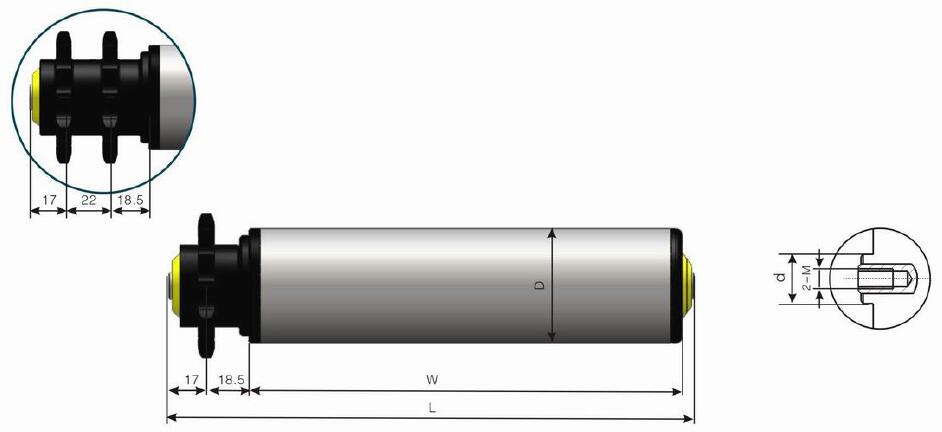
Tube Material | D × T | Shaft | L | Sprocket |
Steel, stainless steel | 50×1.5 | Φ12/Φ15 | L=W+41 | 08B14T |
Steel, stainless steel | 60×2.0 | Φ12/Φ15 | L=W+41 | 08B14T |
This type of roller is widely used in accumulation conveyor systems across various industries, particularly in applications with specific requirements for load capacity and environmental conditions.
Automotive manufacturing industry: Conveyor lines in body painting workshops and assembly shops.
Home appliance manufacturing industry: Assembly and testing lines for products such as washing machines, refrigerators, and air conditioners.
Heavy-duty logistics and warehousing: Accumulation and transportation of pallets and containers.
Industrial drying ovens and coating lines: Conveyor applications that require resistance to high-temperature environments.


