
 |
| Material: | |
|---|---|
| Mounting Method: | |
| Surface Treatment: | |
| Shaft Type: | |
| Quantity: | |
R3221
RONWIN
HS Code: 8431390000
This is a custom-designed functional roller specifically engineered for the telescopic infeed section (or docking section) of an accumulation conveyor. It integrates double-row steel sprockets and is driven by an external chain to synchronize the rotation of the entire roller line, enabling smooth and controlled material transfer in the infeed zone. Its core function is to adapt to variable infeed positions, efficiently and centrally guiding materials into the main conveyor line, and seamlessly interfacing with the downstream accumulation function when required.
This product is not self-driven; it is a key passive actuator within an overall drive system. Its design revolves around three major functions: power transmission, load bearing, and telescopic adaptation.
Roller Body:
Typically a non-powered roller (i.e., no built-in motor).
The surface can be zinc-plated, chrome-plated, or coated (with polyurethane, rubber, etc.) as needed to provide appropriate friction coefficients and wear resistance.
Serves as the direct load-bearing and conveying surface for materials.
Double-Row Steel Sprockets:
Synchronous Drive: A single closed-loop chain engages the corresponding sprockets on all rollers, ensuring synchronized rotation of the entire line and preventing material misalignment.
Load Distribution: The double-row design distributes chain tension across two sprockets, enhancing transmission smoothness and reliability, especially for longer, heavier-loaded telescopic sections.
Precise Transmission: Steel sprockets provide high-precision meshing with the chain, maintaining a constant drive ratio.
Core Feature: Two parallel steel sprockets are securely mounted at one or both ends of the roller shaft.
Material: Typically made from materials like 45# steel or 40Cr, undergoing quenching and tempering heat treatment to ensure high strength and wear resistance.
Functions:
Bearing and Shaft End Structure:
Utilizes heavy-duty deep groove ball bearings or needle roller bearings to ensure smooth rotation under the radial pulling force from the chain.
The shaft end design must be compatible with the support structure of the telescopic mechanism (e.g., slide rail brackets), allowing the roller to move axially (along the length direction).
Telescopic Adaptation Interface:
The roller's drive shaft or mounting bracket is designed to connect with the telescopic section frame of the conveyor.
The chain drive system must also be designed as telescopic (often employing automatic chain tensioners, universal joints, or movable drive modules) to ensure the drive chain maintains proper tension and engagement when the infeed length changes.
System Composition: This roller is the core component of the "telescopic infeed" module. The complete module also includes: a telescopic steel frame, drive motor + reducer, enclosed drive chain, tensioning device, and control system.
Workflow:
The drive motor rotates the drive sprocket via the reducer.
The drive sprocket, via the enclosed loop chain, drives the entire row of double-row sprocket rollers to rotate synchronously.
Materials placed on the rotating rollers are smoothly conveyed to the main line.
When the infeed point needs adjustment, the entire telescopic section (including all rollers and its frame) extends or retracts, driven by a motor or manually. The chain drive system adapts accordingly, maintaining uninterrupted drive.
High Synchronization, Stable Conveying: The double-row sprocket and chain drive ensure absolutely consistent speed across all rollers, effectively preventing material misalignment, slippage, or jamming on the movable section.
High Load Capacity and Reliability: The steel sprocket and heavy-duty bearing design can withstand significant impact loads and continuous stress, suitable for infeed of heavy materials (e.g., plates, profiles, crates).
Designed for Accumulation Function: Perfectly compatible with subsequent accumulation conveyors. When the main line pauses (accumulates), the infeed rollers can stop synchronously; or they can be designed for continuous low-speed operation, coordinating with stoppers in the accumulation zone.
High Adaptability: The telescopic design solves the mismatch between fixed infeed points and variable loading positions, enhancing system layout flexibility.
Relatively Simple Maintenance: Sprocket and chain drive is a mature, reliable mechanical transmission method. Maintenance is intuitive, and replacing wear parts (e.g., the chain) is straightforward.
Automotive Manufacturing: Used in body shops to centrally feed steel sheets or components from material carts to the production line.
Sheet Metal and Building Material Processing: Enables telescopic feeding of plates in coordination with shearing machines or press brakes.
Large-Scale Packaging and Warehousing: Docks heavy crates or pallets from mobile handling equipment to the main accumulation conveyor line.
Assembly Production Lines: Serves as an adjustable-position infeed section, supplying parts to different workstations.
Wood Processing and Furniture Manufacturing: Feeds wood panels or boards into processing centers.
Roller Specifications: Diameter (e.g., Φ60mm, Φ89mm), barrel length, wall thickness.
Sprocket Parameters: Number of teeth (e.g., 10T, 12T), pitch (e.g., ISO 08B, 10A, 12A), row spacing, material, and hardness.
Load Capacity: Rated dynamic and static load per roller.
Shaft End and Bearings: Shaft diameter, bearing type, and lubrication method.
Installation Center Distance: The distance between adjacent rollers, affecting conveying smoothness.
Compatible Chain Model: Must precisely match the sprockets.
Telescopic Stroke: The maximum required travel range for the roller must be specified to customize shaft length and support structure.
Systemic Design: This roller cannot be used alone. It must be part of an integrated design and installation for the complete telescopic infeed drive module.
Chain Tensioning and Alignment: Reliable chain tensioning and guiding mechanisms are essential to prevent skipping or derailing, especially during telescopic movement.
Lubrication and Maintenance: Regular lubrication of sprockets, chains, and bearings is necessary to ensure service life and quiet operation.
Safety Guarding: Exposed chains and sprockets must have removable safety guards to prevent entanglement hazards.
Application area
Internal transporting and accumulating unit handling conveyor systems, such as light weight carboard and containers. Also suitable for implementing buffer sections and for use in the packing industry.
Durable
Using the steel sprocket as the drive head of roller, it is more durable than polyamide sprocket.
Smooth running and low noisy
Precision ball bearing and polymer bearing housing which makes the roller has the advantages of smooth running and low noisy.
Lateral loading
Standard configuration, the bearing housing with end cap and bearing is pressed into the roller tube and the tube ends are rounded, thereby allowing materials to be easily moved on from the side.
Good protection against dirt and water
The design of the end cap seal protects the bearing by providing excellent resistance to dust and splashed water.
Technical data
General technical data | |
Max. load capacity | 20 KGS |
Max. conveyor speed | 30 m/min |
Temperature range | −5 to +40 °C |
Material | |
Tube | Carbon steel, stainless steel |
Shaft | Antirust oil coated steel, Zinc-plated steel, Stainless steel |
Bearing housing | Polyamide, black |
End cap | Polypropylene, yellow/grey |
Bearing | Precision ball bearing |
Drive Element | |
Single/double row sprocket | Zinc-plated steel, black oxidation |
Design versions | |
Surface treatment | Zinc-plated, chrome-plated |
Tube sleeves | PP sleeve, PU sleeve |
Lagging | Rubber, PU |
Diagram of double-row steel sprocket accumulating roller
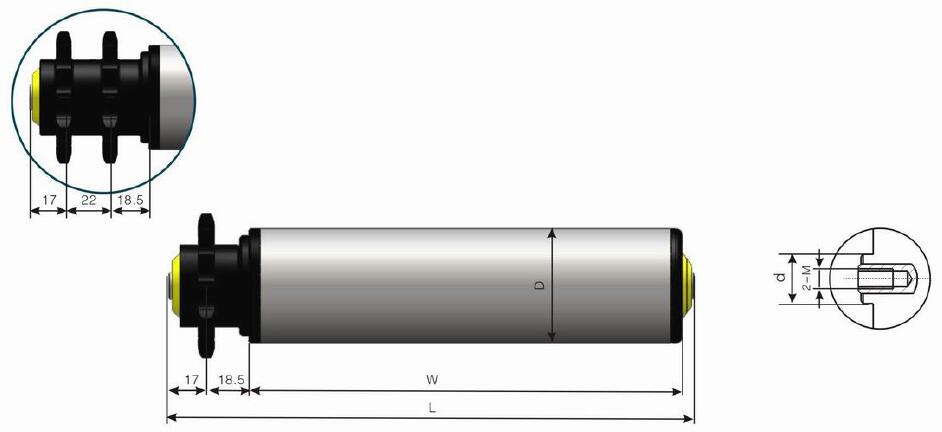
Dimension of series R3221 with female thread installation
Tube Material | D × T | Shaft | L | Sprocket |
Steel, stainless steel | 50×1.5 | Φ12/Φ15 | L=W+63 | 08B14T |
Steel, stainless steel | 60×2.0 | Φ12/Φ15 | L=W+63 | 08B14T |
The double-row steel sprocket telescopic infeed roller for accumulation conveyors is a classic mechanical solution to the technical challenge of variable-distance feeding combined with synchronous, stable conveying. Through its robust double-row sprocket drive design, it combines the traditional load-bearing function of a roller with highly reliable synchronous drive. This ensures a stable, centered material flow to the downstream accumulation line even under dynamic telescoping conditions. Its core value lies in providing the critical guarantee of strength, synchronization, and flexibility for the front-end interface of the entire conveying system.


