|
| Material: | |
|---|---|
| Mounting Method: | |
| Surface Treatment: | |
| Shaft Type: | |
| Quantity: | |
R3214
RONWIN
HS Code: 8431390000
The single-row polymer sprocket accumulating conveyor roller is a high-performance, specialized roller that integrates power transmission and accumulation/buffering functions. It drives all rollers to rotate synchronously via a common drive shaft, while utilizing its unique polymer (engineering plastic) sprocket and accumulation mechanism to achieve smooth material conveyance, forced accumulation, and pressure release on the transfer line. It is a key component in modern modular conveying systems, particularly in assembly lines, packaging lines, and sorting lines handling light to medium loads.
A typical telescope-feed accumulation conveyor roller, the accumulation power of is depended on the load and is automatically changable on some scale.
The bearing unit is critical, which consists of a precision ball bearing, a polymer bearing housing, and an end cover. It is not only for good appearance, but also for smooth and silent operation.
In a working setting, the roller's end cap resists dust and water splashes well.
When compared to standard steel sprockets, high performance polymer sprockets are used as the driving element, resulting in lower operating noise.
The weight of conveyed goods is typically 10-30kg.
Temperatures range from -5°C to +40°C.
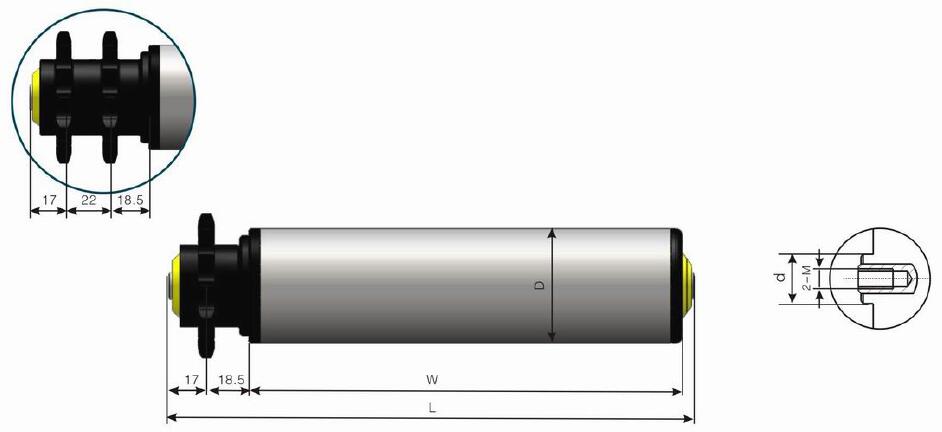
Tube Material | D × T | Shaft | L | Sprocket |
Steel, stainless steel | 50×1.5 | Φ12/Φ15 | L=W+41 | 08B14T |
Steel, stainless steel | 60×2.0 | Φ12/Φ15 | L=W+41 | 08B14T |
Sprocket Drive: Each roller is equipped with a polymer sprocket at one end. A common chain engages all the roller sprockets and is driven by a single drive motor (typically mounted at the conveyor end). This ensures synchronous, same-direction, and same-speed rotation of the entire roller row, providing stable pushing force.
Accumulation Function: A special friction clutch or overrunning clutch mechanism is integrated within the sprocket or roller bearing. When a workpiece on the line is stopped due to an obstruction (e.g., a stopper, busy downstream process), the roller at that obstructed position can automatically stop rotating or idle under the action of its internal clutch, while other unobstructed rollers continue to be driven by the chain.
Pressure Release: Sliding friction occurs between the stopped roller and the still-rotating sprocket, thereby eliminating continuous pressure from the workpiece against the forward obstruction. This prevents workpiece deformation, damage, and line "traffic jams."
| Feature | Advantages & Description |
|---|---|
| Polymer Sprocket | Lightweight: Reduces overall weight and drive load, saving energy. Low Noise: Quieter operation compared to metal sprockets. Self-lubricating/Corrosion Resistant: Suitable for damp, clean, or mildly corrosive environments. Wear Resistant: High-quality engineering plastics (e.g., Nylon, POM) ensure service life. |
| Forced Synchronous Drive | Stable Thrust: All rollers are positively driven by the chain, providing consistent conveying force. Suitable for pushing heavier loads or items with irregular bottoms. Flexible Layout: Drive shaft position is flexible, allowing for long-distance conveyor design. |
| Zero-Pressure Accumulation | Protects Workpieces: Prevents product damage (e.g., carton deformation, product scratches) from mutual compression in the accumulation zone. Reduces Blockages: Creates natural buffering in the production line, balancing pace differences between workstations. Reduces Motor Load: System load automatically decreases during accumulation as some rollers stop. |
| Modular Design | Easy Installation & Maintenance: Standard dimensions allow for quick replacement of individual rollers. Good System Compatibility: Can be easily integrated into existing chain or belt conveyor systems as an accumulation section. |
| Suitable Load | Primarily for light to medium loads, such as cartons, totes, light pallets, plastic containers, component assemblies, etc. |
Packaging Lines: Forms buffer accumulation before sealers, labelers, or palletizers to ensure smooth process flow.
Assembly Lines: Temporarily stores workpieces before assembly stations, allowing operators to work at their own pace, enabling "one-piece flow" or flexible production.
Sorting Systems: Serves as a queue accumulation section before sortation points, ensuring orderly operation of sorters.
Inspection & Rework Stations: Provides temporary storage areas for quality inspection and manual recheck.
Food, Pharmaceutical, Electronics Industries: Suitable for cleanrooms requiring hygiene and corrosion resistance, thanks to the clean and rust-proof properties of the polymer material.
vs. Standard Powered Rollers (Non-Accumulating): Standard rollers cannot achieve zero-pressure accumulation. A forward obstruction causes the entire line to jam or creates severe workpiece compression.
vs. Multi-Row Sprocket Accumulating Rollers: The single-row design is more economical and compact, suitable for narrower conveying paths or lighter loads. Multi-row (double/triple) designs provide greater driving force and stability for wider and heavier loads.
vs. Non-Powered (Gravity) Accumulating Rollers: Non-powered rollers rely on gravity or external force to move items and cannot provide active conveying force on horizontal lines. Their accumulation effect depends on the rollers' inherent rotational resistance.
The single-row polymer sprocket accumulating conveyor roller is an ingenious engineering solution that addresses line flow and buffer balancing challenges. It combines positive chain drive with a flexible clutch-based accumulation mechanism and optimizes performance, cost, and durability through the use of polymer sprockets. For automated material handling systems that require synchronous conveyance and controlled accumulation on horizontal or slight-incline lines, this product is a reliable and efficient core component choice.