Views: 0 Author: Site Editor Publish Time: 2026-07-14 Origin: Site

Inefficient pallet transport creates massive operational friction in modern warehouses. Mismatched material handling equipment quickly leads to workflow bottlenecks, severe product damage, and bloated energy consumption. Facility managers constantly face the tension between minimizing upfront capital expenditure and achieving strict throughput, pacing, and safety standards. You cannot afford to guess which system fits your floor.
Choosing the right transport mechanism requires a hard look at your load profiles, facility layout, and long-term automation objectives. The core comparison usually comes down to evaluating a Gravity Roller Conveyor against powered alternatives. Both systems move heavy loads, but they serve entirely different operational cadences. Understanding the mechanical limits and integration capabilities of each ensures your facility maintains flow without overspending on unnecessary automation. We will break down the mechanical realities of both approaches.
Application Fit: A gravity roller conveyor is highly cost-effective for short-distance, manual staging, and low-frequency pallet moves, whereas powered systems are mandatory for long runs, inclines, and automated pacing.
Throughput Cadence: The choice often hinges on duty cycle frequency—gravity systems excel in low-frequency daily staging, while powered systems are engineered for high-frequency hourly pacing.
Cost Dynamics: Gravity systems offer significantly lower upfront costs and zero energy consumption, but powered systems deliver better long-term ROI in high-throughput, labor-constrained environments.
Safety & Control: Powered conveyors enable zero-pressure accumulation and precise zone control, mitigating the risk of heavy pallet collisions inherent in gravity-fed declines.
Scalability & Modularity: Facilities planning future integration with Automated Storage and Retrieval Systems (AS/RS) or Autonomous Mobile Robots (AMRs) must leverage the modularity and digital integration capabilities of powered roller systems.
Table of Contents
Gravity systems function entirely on unpowered rollers. They rely on a calculated decline pitch or manual operator force to move heavy pallets from one zone to another. A standard gravity line utilizes a 1.5% to 4% grade. This pitch allows gravity to overcome the rolling resistance of the bearings. Operators simply load the pallet at the high end, and it rolls to the discharge point. For flat installations, workers manually push the loads along the track. This method requires zero electricity and minimal complex machinery. The physics are straightforward. You match the weight of the load to the friction coefficient of the bearings. If the pitch is too steep, the pallet accelerates out of control. If the pitch is too shallow, the pallet stalls. Finding the exact angle requires testing your specific pallets on the actual roller material.
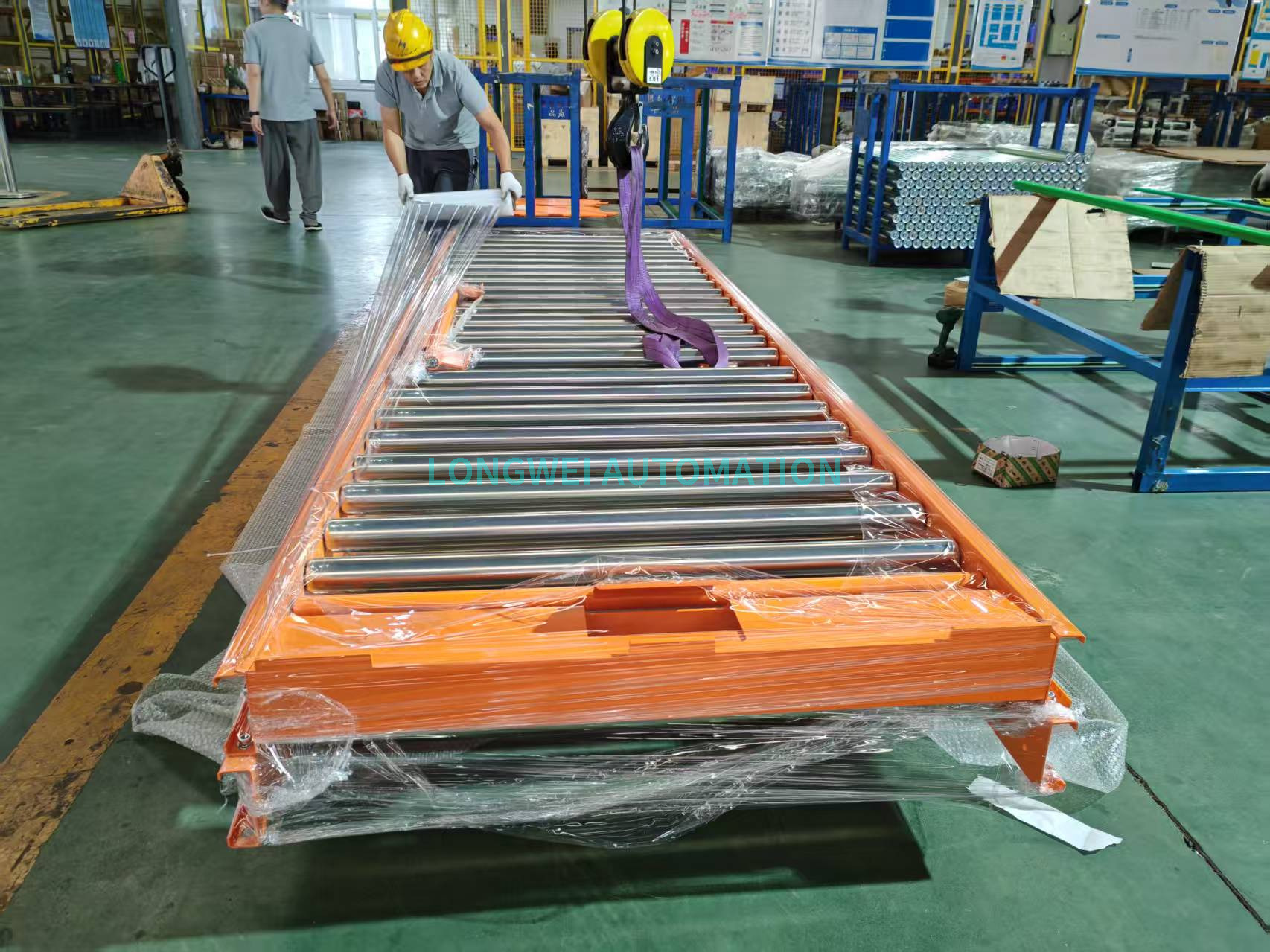
The construction of a gravity line prioritizes structural integrity. Heavy-duty structural steel frames form the backbone. These frames support high-capacity rollers ranging from 1.9 inches to 3.5 inches in diameter. Precision ball bearings sit inside each roller tube. These bearings reduce friction, allowing heavy wooden or plastic pallets to glide smoothly. The axle shafts lock into the side frames, creating a rigid bed capable of withstanding severe impact loads from forklifts. Frame thickness matters immensely. A 10-gauge steel frame might handle light totes, but structural channel frames are mandatory for 2,500-pound pallets. Hexagonal axles prevent the inner bearing race from spinning, which extends the lifespan of the roller. Cross-bracing between the side frames prevents the conveyor from racking under heavy side-loads during forklift induction.
Gravity systems handle much more than standard GMA pallets. They accommodate diverse heavy footprints across various industries. Drum pallets, heavy industrial totes, and lumber runners all travel effectively on unpowered rollers. The key is ensuring the bottom surface of the load makes consistent contact with at least three rollers at all times. This prevents the load from dipping between the rollers and stalling the line. Slave pallets or slip sheets often require tighter roller centers. If you run a 48x40 pallet, standard 4-inch or 6-inch roller centers work fine. If you run custom skids with narrow runners, you might need 3-inch centers to maintain that critical three-roller contact rule. The system adapts to the load footprint through mechanical spacing rather than software logic.
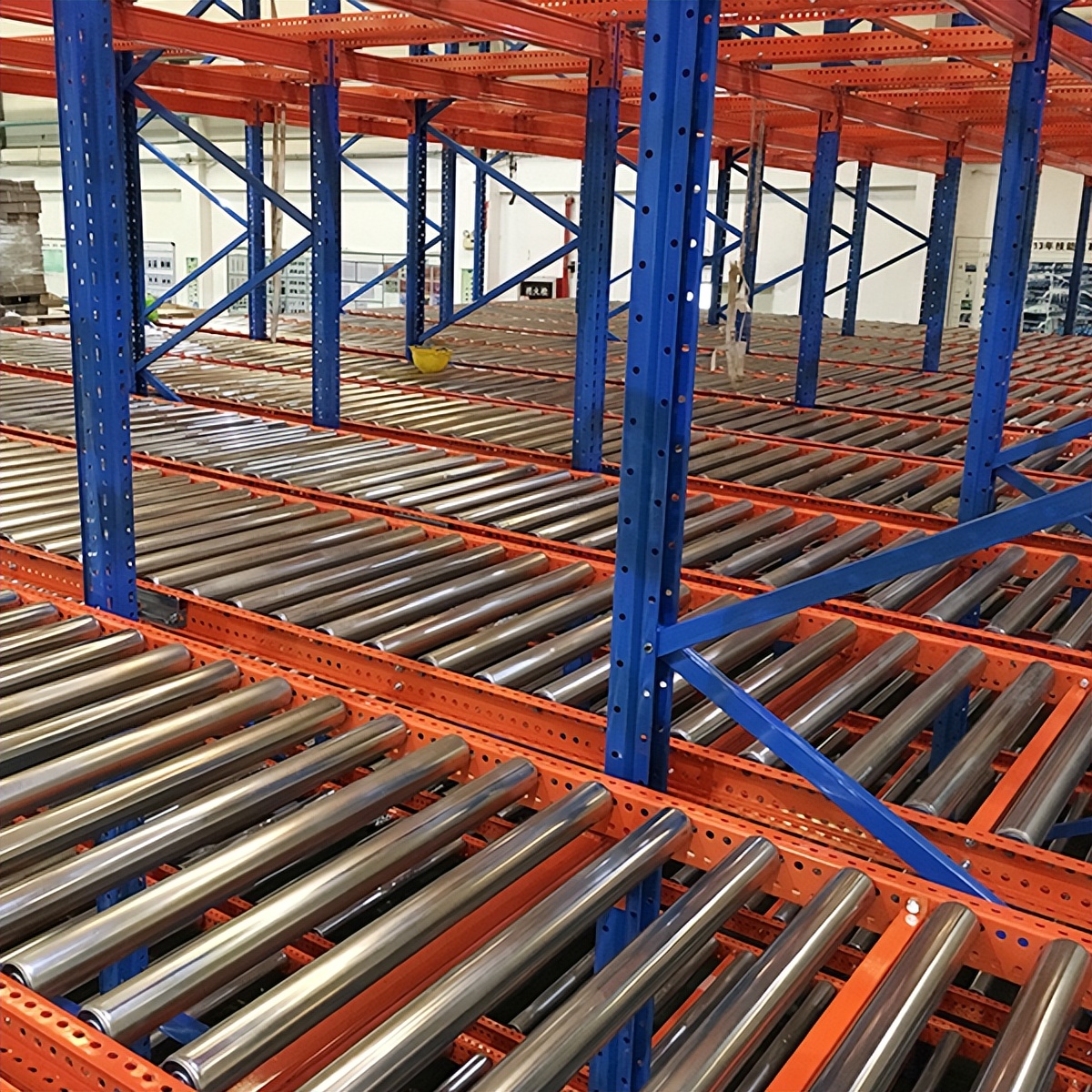
Certain scenarios make unpowered systems the superior choice. End-of-line packaging staging benefits greatly from simple gravity flow. Gravity flow rack lanes utilize these rollers for high-density, first-in-first-out storage. Short-span manual push lines are highly effective for workstations where operators need to inspect or modify loads. Generally, transport distances under 20 feet represent the sweet spot for unpowered roller applications. Pick modules frequently use unpowered lanes to feed empty pallets back to the induction zone. Cross-docking operations use short gravity sections to buffer loads between the receiving dock and the outbound trailers. When you do not need precise pacing, unpowered rollers get the job done without over-engineering the floor.
Powered transport relies on external motors to drive the rollers. Chain-Driven Live Rollers (CDLR) and Motorized Drive Rollers (MDR) dominate heavy pallet handling. CDLR systems use a continuous chain looped around sprockets welded to each roller. When the motor turns, the chain drives all connected rollers simultaneously. MDR systems place an internal motor inside specific rollers, dividing the conveyor into distinct, individually controlled zones. Both methods provide absolute control over pallet movement regardless of the floor grade. You can move loads horizontally for hundreds of feet without losing speed. The motors dictate the pace. If the downstream equipment stops, the conveyor stops. This creates a synchronized material flow that unpowered systems simply cannot replicate.
Roller-based systems consistently outperform belt conveyors for heavy pallet transport. Rollers handle point-load distribution far better than flat belts. A heavy pallet with damaged bottom boards will easily tear a fabric or rubber belt. Rollers resist this bottom-board damage. Furthermore, belts cannot support heavy accumulation. If a heavy pallet stops on a moving belt, the friction burns the belt material and damages the drive motor. Rollers allow for safe, controlled accumulation. Belt tracking also becomes a nightmare with heavy, off-center loads. A 3,000-pound pallet sitting slightly to the left will push a belt off its pulleys. Steel rollers stay fixed in their frames, ignoring off-center weight distribution entirely.
Powered lines require complex external mechanisms. AC gearmotors provide the primary driving force for CDLR lines. Sprockets and heavy-duty drive chains transfer this power to the rollers. MDR systems utilize O-rings or poly-V belts to link unpowered rollers to the motorized drive roller. Programmable logic controllers (PLCs) act as the brain of the system. Photo-eye sensors feed data to the PLC, telling the motors exactly when to start and stop based on pallet positioning. Variable Frequency Drives (VFDs) allow operators to adjust the speed of the AC motors on the fly. Pneumatic valves control pop-up transfers and blade stops. The wiring infrastructure alone requires dedicated cable trays and extensive electrical engineering.
Powered systems shine in demanding environments. Continuous high-speed transport across massive distribution centers requires motor-driven pacing. Routing pallets through complex facility layouts with curves and diverts demands powered control. Precise indexing for robotic palletizers relies on the exact stopping capabilities of motorized zones. Any layout requiring elevation changes or long horizontal runs must utilize powered transport to maintain workflow. Feeding an AS/RS crane requires millimeter-level precision. The conveyor must position the pallet exactly over the crane's pickup forks. Only motorized, sensor-driven zones can achieve this accuracy. Stretch wrappers also require powered feed lines to automatically index the next pallet into the wrapping zone the moment the previous one exits.
Structural limits dictate your equipment choices. Heavy-duty CDLR systems easily handle extreme pallet weights exceeding 4,000 pounds. The welded sprockets and thick steel chains provide immense driving torque. A Gravity Roller Conveyor also supports massive weights, often up to 3,000 pounds per pallet, provided the frame thickness and roller diameter are properly specified. However, moving a 3,000-pound load manually on a flat gravity line causes severe operator fatigue. You must match the roller wall thickness to the impact load. Dropping a heavy pallet onto thin-walled rollers will dent the tubes, ruining the bearings and halting flow.
Bottom board condition directly affects travel reliability. Damaged, warped, or non-standard pallets frequently stall on unpowered lines. The rolling resistance becomes too great for gravity to overcome. Plastic pallets often lack the friction needed to roll smoothly on unpowered steel rollers. Powered systems force these difficult loads through the line. The driven rollers grip the pallet and pull it forward, regardless of minor bottom-board defects or material composition. CHEP and PECO block pallets generally travel well on both systems, but stringer pallets with missing boards will catch on unpowered rollers. Motorized systems power through these imperfections.
Footprint variability influences roller centers and frame width selection. Standard GMA pallets require different roller spacing than oversized industrial skids. You must ensure the load never drops between the rollers. Both systems offer customizable roller centers. However, powered systems require more engineering to ensure the drive mechanisms do not interfere with overhanging load footprints. If a load hangs over the edge of the pallet, it can catch on the raised chain guards of a CDLR system. Unpowered frames can be built flush, allowing oversized loads to hang over the side frames without hitting any drive components.
Evaluate your duty cycle frequency. Low-frequency staging involves periodic daily moves. Operators might load a few pallets per shift. Unpowered systems perfectly match this low cadence. High-frequency operations demand continuous hourly flow. When you need to move sixty pallets an hour across a facility, manual pushing or gravity declines cannot maintain the pace. Powered automation becomes strictly necessary for high-cadence environments. You calculate your Pallets Per Hour (PPH) requirement first. If your PPH exceeds what a forklift driver can manually load and unload in a given zone, you need motorized transit to buffer the flow.
Gravity transport yields variable, unpredictable speeds. A heavy pallet rolls faster than a light one. Environmental factors like humidity can change bearing friction. Powered conveyors provide highly regulated, programmable speed. You control exactly how fast the load moves. Precise pallet spacing is critical for downstream automated processes. Robotic stretch wrappers and automated strapping machines require pallets to arrive at exact intervals. Only powered systems deliver this pacing. You can program a PLC to release one pallet every forty-five seconds, ensuring the downstream machinery never starves and never jams.
Accumulation defines how pallets queue on the line. Basic mechanical stops on gravity lines halt the lead pallet. Subsequent pallets roll down and crash into the back of the queue. This creates immense line pressure and causes severe product damage. Powered systems utilize zero-pressure accumulation (ZPA) logic. Sensors detect pallets and shut off individual motor zones. Pallets queue up with a set gap between them, never touching and never creating line pressure. ZPA protects fragile goods. If you ship glass bottles or electronics, you cannot allow pallets to slam into each other on a decline track.
Unpowered systems face strict directional limits. They only work on declines or flat manual-push runs. You cannot move a heavy pallet up an incline without a motor. Powered systems manage inclines, declines, and long horizontal distances without any labor intervention. They push loads over long spans, maintaining consistent speed regardless of the floor's topography. If your dock doors sit higher than your warehouse floor, you need a motorized incline to bridge the gap. Unpowered lines simply cannot move material uphill.
Integrating curves, transfers, and diverts adds layout flexibility. Unpowered gravity curves exist, but they carry a high risk of pallet skewing. The load often jams against the outer guardrail. Powered curves use tapered rollers and dedicated drives to maintain pallet orientation. Pop-up chain transfers and right-angle diverts require powered mechanisms to lift and redirect heavy loads. Complex routing demands motorized integration. You can build a massive loop around your facility with motorized zones, sorting pallets to different shipping lanes based on barcode scans. Unpowered lines restrict you to straight, point-to-point travel.
The initial hardware and installation disparity is massive. Unpowered lines require minimal installation. Technicians bolt the frames to the floor, drop in the rollers, and the system is ready. Powered systems demand extensive infrastructure. You must account for heavy electrical wiring, motor installation, pneumatic plumbing for pop-up transfers, and complex PLC programming. The control cabinets and sensor arrays significantly increase the initial capital required to launch the system. You also pay for the software integration. Programming the routing logic and tying the conveyor PLC into your Warehouse Management System (WMS) requires specialized engineering hours.
Ongoing utility costs heavily favor unpowered systems. Gravity requires zero electricity. The energy consumption is nonexistent. Powered systems draw continuous power. Even efficient MDR systems that only run when a pallet is present consume electricity. You must also factor in the hidden labor costs. Manual pushing, clearing jams, and physical operator fatigue on unpowered lines reduce overall productivity. Powered lines eliminate this ergonomic overhead, saving labor hours over time. You trade the utility bill for labor efficiency. In markets with high warehouse turnover, reducing physical labor through motorized transport often justifies the electrical draw.
Wear-and-tear profiles differ drastically. Unpowered systems have fewer moving parts. Bearings and rollers represent the only wear items, resulting in lower maintenance frequency. Powered lines involve chains, sprockets, gearboxes, and sensors. A snapped drive chain or a failed motor halts the entire line, causing significant downtime. Swapping a single dead roller on an unpowered line takes minutes and rarely stops production. Modular roller designs in both systems do help simplify component replacement when failures occur. You must stock spare motors, VFDs, and photo-eyes for motorized lines. Unpowered lines only require a few spare rollers and a wrench.
Feature | Gravity Roller Conveyor | Powered Roller Conveyor |
|---|---|---|
Energy Requirement | None (Gravity/Manual) | High (Electricity/Pneumatics) |
Accumulation | Mechanical stops (creates line pressure) | Zero-Pressure Accumulation (ZPA) |
Speed Control | Variable / Unpredictable | Precise / Programmable |
Maintenance Complexity | Low (Bearings, Rollers) | High (Motors, Chains, PLCs) |
Best For | Short staging, low throughput | Long runs, high throughput, automation |
Runaway heavy pallets pose a severe risk on steep gravity declines. A 2,500-pound pallet moving too fast can destroy end-stops and injure workers. Operator strain from pushing stalled loads on flat runs also leads to workplace injuries. Mitigate these risks by calculating precise pitch angles. Install centrifugal speed controllers, often called brake rollers, to govern the descent speed. For loads exceeding safe manual handling limits, always utilize powered transport. You must also install physical guarding around motorized chains and sprockets to prevent pinch-point injuries. Safety requires matching the equipment to the physical limits of your workforce.
Misalignment between conveyor discharge points and forklift pickup protocols disrupts workflow. AS/RS or AMR systems cannot interface with unpredictable unpowered lines. Mitigate integration failures by specifying heavy-duty impact zones for forklift loading on unpowered lines. Ensure powered lines feature the necessary sensor arrays and communication protocols for automated hand-offs. The conveyor must talk to the mobile robots to ensure safe load transfers. Forklift drivers will inevitably hit the conveyor frames. Install heavy steel guardrails and floor-mounted bollards around the induction zones to protect the equipment from daily abuse.
Outgrowing a static unpowered system happens quickly as throughput demands increase. Ripping out bolted frames to install motors later disrupts operations. Mitigate this by designing hybrid systems from the start. Use unpowered lines for simple end-of-line staging where speed does not matter. Deploy powered lines for main transport arteries. This hybrid approach balances initial costs with long-term scalability. Plan your floor layout with expansion in mind. Leave physical space for future motorized loops even if you only install unpowered staging lanes today.
Choosing between a Gravity Roller Conveyor and a powered conveyor system ultimately depends on your throughput requirements, facility layout, automation goals, and long-term operating costs. Selecting the right solution based on your actual material handling needs will help maximize efficiency, improve safety, and reduce maintenance over the life of the system.
Working with an experienced conveyor manufacturer can make the selection process more efficient and reliable. Longwei specializes in gravity roller conveyors, powered conveyor systems, and customized material handling solutions for warehouses, logistics centers, and industrial facilities. With extensive engineering experience and professional manufacturing capabilities, Longwei helps customers develop reliable conveyor systems tailored to their operational requirements.
Before making a final decision, consider these recommended steps:
Map your exact transport distances and elevation changes across the facility floor.
Calculate your required pallets-per-hour to determine if manual staging can keep up with production.
Test your specific pallet bottom-board integrity on different roller types to ensure smooth travel.
Design a hybrid layout that places unpowered staging at workstations and powered transport on main transit arteries.
A: Heavy-duty structural capacities allow these systems to handle massive loads. Depending on the roller diameter, wall thickness, and frame construction, they typically support up to 3,000+ lbs per pallet. Proper roller spacing ensures the weight distributes evenly across multiple axles.
A: No. Long horizontal runs require manual pushing. Pushing heavy pallets over long distances causes severe operator fatigue and ergonomic injuries. Without a decline pitch, gravity cannot assist, making unpowered systems highly impractical for long horizontal transport.
A: Speed control relies on proper pitch calculation and specialized hardware. You install indirect brake rollers or centrifugal speed controllers within the line. These devices create resistance as the pallet accelerates, governing the descent speed and preventing dangerous runaway loads.
A: Concentrated pallet weight easily causes belt stretching and tearing. Wooden bottom boards often splinter and puncture fabric belts. Rollers distribute heavy loads across rigid steel axles, resisting damage and allowing for safe accumulation without burning out drive motors.
A: Unpowered lines require simple mechanical anchoring to the floor. Powered systems demand extensive electrical wiring, motor mounting, pneumatic air lines for transfers, and complex PLC programming to synchronize the sensor arrays and drive zones.
A: Yes. Hybrid systems are highly effective and common. Facilities frequently use unpowered lines for end-of-line manual staging or packaging stations, and then transfer the pallets onto powered lines for high-speed transit to the warehouse or shipping docks.
A: Zero-pressure accumulation (ZPA) prevents pallets from touching while queued, eliminating line pressure. True ZPA requires powered zones and sensors to start and stop individual sections. Unpowered systems only offer mechanical blade stops, which inherently cause pallets to bump and create line pressure.