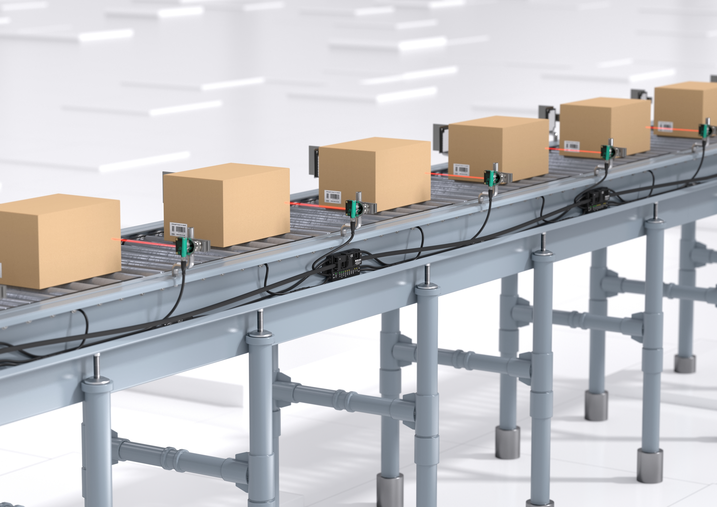
Sensor-controlled conveyor zones automatically stop and release products according to downstream availability, reducing contact pressure during accumulation.
Before diving deeper, it is essential to understand the term “ZPA.” ZPA stands for Zero Pressure Accumulation.
This is an intelligent conveying control logic based on the following principles:
Zone control: The entire conveyor line is divided into multiple independently controlled short zones.
Non‑contact accumulation: When a zone is occupied by a load, the upstream zone immediately stops conveying, ensuring that loads always maintain a safe distance from each other – no collisions or compression (squeezing) occur.
On‑demand drive: The system only drives the rollers when a load needs to move, rather than running continuously, thereby significantly saving energy.
2. Two Drive Options – A Detailed Comparison
While both configurations deliver zero‑pressure accumulation, they differ in physical design and application suitability.
Aspect
ZPA Motor Driven Roller Conveyor
External‑Motor Accumulation Roller Conveyor
Core definition
A ZPA conveying system where each zone is driven directly by a motorized roller (with an integrated motor and gearbox).
A ZPA conveying system driven by a traditional motor (e.g., geared motor) mounted externally (above, below, or beside the conveyor) and transmitting power via chains, belts, or other mechanical components.
Power source
Distributed. Power is decentralised inside the motorised rollers of each zone.
Centralised. Typically powered by a single large motor, with power distributed to individual zones via mechanical transmission.
Accumulation control
Electronic control. Intelligent communication between zone‑resident control cards and sensors (e.g., photoelectric sensors) precisely starts and stops the motorised rollers. Control logic can even be embedded in the modules, potentially eliminating the need for a PLC.
Mechanical / pneumatic control. Accumulation is achieved through complex mechanical structures (e.g., clutches, brakes, switchable belt‑press devices) or pneumatic components that engage/disengage the roller drive.
Key characteristics
- Energy efficient: On‑demand operation consumes very little power. - Compact design: Integrated motor saves space. - Low maintenance: Motorised rollers are typically maintenance‑free and need no lubrication. - Smart control: Easy to implement complex logic such as speed adjustment and soft start/stop. - Low noise: Quiet operation.
- Potentially lower initial cost: For simple long straight conveyors, the upfront investment may be lower than with motorised rollers. - Mature technology: Long history and proven reliability. - Higher maintenance: Chains, belts, and other drive components require regular servicing and lubrication. - Higher noise: Mechanical transmission tends to generate more noise. - Higher energy consumption: The main motor and transmission often run continuously even without loads, leading to greater energy use.
3. How Each System Works
ZPA Motor Driven Roller Conveyor
The conveyor is divided into multiple zones. Each zone contains one or more motorized rollers, sensors, and a smart control card. Zones communicate with each other via a bus (e.g., Easy‑Bus). When a sensor detects a load in its zone, the control card drives the motor driven roller to move it. If the downstream zone is occupied, the rollers in the current zone stop, achieving zero‑pressure accumulation. The entire process is decentralised and intelligent.
External‑Motor Accumulation Roller Conveyor
A central motor (usually a geared motor) provides the power. Power is transmitted via flat belts, chains, or other drive elements to the individual rollers. To enable accumulation, additional control mechanisms are required – for example, a switchable device that presses a flat belt against the rollers to engage drive, or a clutch that disconnects the rollers from the drive chain. This approach relies more on mechanical actions and typically has slower response times and less flexibility than electronic control.
4. Core Difference
The key difference between ZPA motor driven roller conveyors and external-motor accumulation roller conveyors lies in the drive power source and the method used to achieve accumulation (ZPA functionality). The former integrates the motor inside the roller, offering a more modern, efficient, and intelligent solution, while the latter uses a traditional external motor, representing a more mature and conventional approach.
5. Typical Applications
ZPA Motor Driven Roller Conveyor
Widely used in modern logistics centres, e‑commerce warehouses, courier sorting lines, and other environments that demand energy efficiency, intelligent control, low noise, and high reliability. Particularly suitable for applications with frequent starts/stops and diverse load types.
External‑Motor Accumulation Roller Conveyor
More commonly found in cost‑sensitive settings, simpler conveying environments, or applications with heavier or bulkier loads – such as traditional manufacturing production lines, heavy industry, and automotive assembly.
6. Summary
In essence, the ZPA motor driven roller conveyor represents a more advanced conveying technology. By decentralising power and control to each zone, it achieves efficient, intelligent, and low‑maintenance material handling. In contrast, the external‑motor accumulation roller conveyor is a more traditional, proven solution that relies on centralised power and mechanical structures to accomplish accumulation.
The Zero Pressure Accumulation (ZPA) Roller Conveyor divides the conveyor into independently controlled zones, allowing cartons, totes, pallets, and other unit loads to accumulate without continuous pushing pressure between products.
Sensors detect the presence of each load and communicate with the conveyor control system to start or stop individual zones as required. This enables controlled product spacing, accumulation, and release while reducing unnecessary contact between adjacent loads.
Available with Motor Driven Roller (MDR) or gear motor drive configurations, the ZPA conveyor is suitable for automated warehouses, sorting systems, production lines, packaging operations, and other applications requiring controlled product buffering.
How Does a Zero Pressure Accumulation Conveyor Work?
A zero pressure accumulation conveyor divides a conveying line into multiple independently controlled zones.
Each zone typically consists of:
A drive unit
Driven rollers
Product detection sensors
Zone control components
PLC or accumulation controller
Instead of running the entire conveyor continuously, individual zones start and stop according to product position and downstream availability.
Accumulation Mode
When a product enters a conveyor zone, the sensor detects its presence.
If the downstream zone is occupied, the control system stops the current zone. The rollers stop rotating and the product remains stationary.
Upstream products are stopped in their respective zones, creating controlled spacing between accumulated loads.
This reduces the pushing force and continuous product-to-product pressure associated with conventional accumulation methods.
Release Mode
When the downstream zone becomes available, the controller restarts the appropriate zone and allows the product to move forward.
The next accumulated product can then be released according to the programmed control sequence.
This zone-by-zone operation allows the conveyor to buffer products while maintaining controlled material flow.
Key Features of the ZPA Roller Conveyor
Zero Pressure Product Accumulation
Each product can occupy an independently controlled conveyor zone.
When downstream movement is blocked, the corresponding zone stops rather than continuing to push products forward.
This makes ZPA particularly useful for cartons, totes, finished products, and other loads where reducing contact and accumulation pressure is important.
Independent Zone Control
Each conveyor zone can operate according to sensor feedback and control logic.
This allows the system to respond dynamically to changing downstream conditions instead of running all conveyor sections continuously.
Automatic Product Detection
Photoelectric or proximity sensors detect whether a zone is occupied.
Sensor signals are used by the controller to determine when each zone should run, stop, accumulate, or release products.
Controlled Product Spacing
Because products are accumulated in separate zones, the conveyor can maintain spacing between loads during buffering.
This can help improve downstream feeding to sorting, packing, inspection, scanning, and production processes.
On-Demand Zone Operation
Only the conveyor zones required for product movement need to operate.
Unoccupied or blocked zones can remain stopped until conveying is required again.
Modular Conveyor Configuration
The conveyor can be divided into multiple control zones according to product length, required accumulation capacity, conveyor layout, and process requirements.
ZPA Conveyor System Architecture
A typical zero pressure accumulation system includes several components working together.
Component
Function
Conveyor Rollers
Support and move products
Drive Unit
Powers rollers within each zone
Sensors
Detect product presence and zone occupancy
Zone Controller
Controls local zone start/stop operation
PLC / Main Controller
Coordinates conveyor logic and upstream/downstream equipment
Frame & Supports
Provide mechanical conveyor structure
Communication Interface
Exchanges signals with other automation equipment where required
The final control architecture depends on conveyor length, number of zones, product flow logic, and integration requirements.
Two ZPA Conveyor Drive Options
RONWIN ZPA conveyors can be configured with either a gear motor drive or a Motor Driven Roller (MDR) system.
Both can provide zero-pressure accumulation, but their mechanical structure and application characteristics are different.
Motor Driven Roller (MDR) ZPA Conveyor
A Motor Driven Roller integrates a compact electric motor inside the roller tube.
The MDR acts as the drive roller for an individual conveyor zone and transfers power to adjacent rollers.
Typical configurations use 24V or 48V DC power with dedicated zone controllers.
Key Advantages:
Compact drive structure
No large external motor beside the conveyor
Independent zone operation
Flexible modular configuration
Suitable for shorter accumulation zones
Easy integration into automated conveyor systems
Well suited to carton, tote, and parcel handling
Recommended For:
E-commerce fulfillment
Parcel handling
Carton conveying
Tote handling
Packaging lines
Automated warehouse systems
Light-to-medium-duty production flow
Gear Motor Driven ZPA Conveyor
A gear motor configuration uses an external geared motor to transmit power to conveyor rollers through chains, belts, shafts, or other transmission components.
A single gear motor can drive a longer conveyor zone and provide higher torque for demanding material handling applications.
Key Advantages:
Higher torque capability
Suitable for longer powered zones
Suitable for heavier unit loads
Flexible transmission configurations
Practical for industrial and pallet handling applications
Recommended For:
Pallet conveying
Heavy industrial components
Automotive material handling
Building material handling
Heavy packaging lines
Long accumulation zones
Motor Driven Roller vs. Gear Motor ZPA Conveyor
Feature
Motor Driven Roller (MDR)
Gear Motor Drive
Drive Location
Motor integrated inside roller
External geared motor
Typical Power Supply
24V / 48V DC
220V / 380V AC
Typical Zone Length
Approx. 500–1500 mm
Approx. 2000–4000 mm
Conveyor Structure
Compact and modular
Larger external drive system
Zone Control
Highly flexible
Suitable for longer zones
Torque
Suitable for light-to-medium loads depending on configuration
Suitable for higher-torque applications
Installation Space
Compact
Requires external motor/transmission space
Typical Application
Cartons, totes, parcels
Heavy unit loads, pallets
Control
Zone controller / PLC
PLC / VFD depending on configuration
The final drive method should be selected according to product weight, dimensions, zone length, conveyor speed, required accumulation capacity, and operating environment.
Zero Pressure Accumulation Conveyor Specifications
Parameter
Gear Motor Drive
Motor Driven Roller Drive
Zone Drive Power
Approx. 0.37–1.5 kW
Approx. 35–150 W
Typical Zone Length
2000–4000 mm
500–1500 mm
Maximum Single-Item Weight
Up to 1500 kg*
Up to 1500 kg*
Conveying Speed
Approx. 0.1–0.5 m/s
Approx. 0.1–2.0 m/s
Speed Control
VFD Controlled
PWM / Controller
Operating Voltage
380V / 220V AC
24V / 48V DC
Typical Protection Rating
IP54–IP55
IP55–IP66
Maximum load capacity depends on roller diameter, roller pitch, drive selection, frame structure, zone length, support spacing, load distribution, and final conveyor configuration. Heavy-load applications should be confirmed according to the actual project requirements.
How to Determine the ZPA Zone Length
Zone length is an important factor in designing a zero pressure accumulation conveyor.
In many ZPA applications, each zone is designed to accommodate one product or one controlled load position.
The appropriate zone length depends on:
Product length
Required gap between products
Sensor position
Conveyor speed
Product stopping distance
Accumulation logic
Drive configuration
For carton and tote handling, shorter MDR-controlled zones can provide flexible accumulation.
For larger or heavier loads, longer zones with a suitable gear motor configuration may be more appropriate.
The final zone length should be determined according to actual product dimensions and control requirements rather than using one fixed value for every application.
ZPA Conveyor vs. Friction Accumulation Conveyor
Traditional friction accumulation conveyors use mechanical slip or friction components to allow products to stop while portions of the conveyor drive continue operating.
A ZPA conveyor uses sensors and independently controlled zones to stop the rollers beneath an accumulated product.
Feature
ZPA Roller Conveyor
Friction Accumulation Conveyor
Accumulation Method
Sensor-controlled zone stopping
Mechanical friction/slip
Roller Under Stopped Product
Stops
May continue to be driven through friction mechanism
Product Pressure
Very low / controlled
Contact pressure may occur
Product Spacing
Can maintain individual zones
Products may accumulate in contact
Control Flexibility
High
Primarily mechanical
Sensors & Controls
Required
Fewer controls required
Mechanical Wear
Reduced friction during accumulation
Friction components are wear items
Initial System Complexity
Higher
Lower
Best For
Controlled automated buffering
Simpler mechanical accumulation
When Should You Choose ZPA?
Choose a zero pressure accumulation conveyor when:
Products should not continuously push against each other
Controlled spacing between products is required
Products need to wait before downstream equipment
The conveyor needs automatic start/stop control
Product flow changes according to downstream availability
The system must integrate with automated equipment or controls
A friction accumulation conveyor may remain suitable for simpler applications where precise spacing and independent zone control are unnecessary.
Typical ZPA Conveyor Applications
E-Commerce and Parcel Handling
ZPA conveyors can buffer cartons and parcels before sorting, scanning, labeling, packing, or dispatch processes.
Automated Warehouse Systems
Independent conveyor zones allow products to wait automatically when downstream sections, transfer units, or workstations are occupied.
Packaging Lines
Products can accumulate before case packing, labeling, inspection, sealing, or palletizing equipment without continuous pushing pressure.
Manufacturing and Assembly Lines
ZPA conveyors can buffer components or finished products between production processes where upstream and downstream cycle times differ.
Carton and Tote Handling
MDR-based ZPA conveyors are particularly suitable for controlled movement and accumulation of cartons and totes.
Pallet and Heavy Load Handling
Gear motor configurations can be designed for heavier unit loads where higher torque, reinforced rollers, and stronger conveyor frames are required.
Where Is Zero Pressure Accumulation Most Useful?
ZPA is particularly useful when the upstream process continues producing goods but the downstream process temporarily stops or operates at a different cycle time.
For example:
Production → ZPA Buffer → Inspection
Packing → ZPA Buffer → Labeling
Picking → ZPA Buffer → Sorting
Conveyor → ZPA Buffer → Palletizing
Instead of stopping the entire upstream process immediately, the ZPA conveyor provides temporary accumulation capacity and releases products when downstream equipment becomes available.
How to Choose a ZPA Roller Conveyor
Before selecting a zero pressure accumulation conveyor, consider the following factors.
Product Dimensions Provide the length, width, and height of each carton, tote, pallet, or unit load.
Product Weight Product weight affects roller selection, drive torque, frame structure, and whether MDR or gear motor drive is more appropriate.
Required Accumulation Capacity Determine how many products need to wait on the conveyor at the same time.
Zone Length Zone length should be selected according to product length, spacing, stopping distance, and control requirements.
Conveying Speed The required throughput and upstream/downstream process speed determine the appropriate conveyor speed.
Drive Type MDR is generally suitable for modular carton, tote, and parcel handling. Gear motor configurations should be considered for heavier loads or longer powered zones.
Control Logic Confirm whether products need single release, sequential release, controlled spacing, FIFO flow, or coordination with downstream equipment.
System Integration Identify any required communication with PLCs, scanners, sorters, packing machines, robots, transfer units, or other automation equipment.
Is Your Product Suitable for a ZPA Conveyor?
ZPA roller conveyors are particularly suitable for stable unit loads with flat and sufficiently rigid bottoms.
Typical Products Include:
Cartons
Boxes
Plastic totes
Trays
Cases
Packaged products
Selected industrial components
Pallets with suitable conveyor contact surfaces
Soft, flexible, irregularly shaped, or very small products may require trays, totes, special roller spacing, or another conveying method.
Product dimensions, bottom condition, weight, and orientation should therefore be confirmed before final conveyor design.
Zero Pressure Accumulation Conveyor FAQs
What does ZPA mean in conveyor systems?
ZPA stands for Zero Pressure Accumulation. It refers to a conveyor control method that allows products to accumulate in independently controlled zones while minimizing pushing pressure between adjacent loads.
How does a ZPA roller conveyor detect products?
Photoelectric or proximity sensors detect product presence within each conveyor zone. The controller uses these signals to determine whether the zone should run, stop, or release a product.
What is a ZPA conveyor zone?
A zone is an independently controlled section of the conveyor. In many applications, one zone is designed to hold one product during accumulation.
What is the difference between ZPA and a standard powered roller conveyor?
A standard powered roller conveyor primarily moves products continuously. A ZPA conveyor adds sensors, independent drive zones, and control logic so products can automatically stop, accumulate, and restart according to downstream conditions.
What is the difference between ZPA and friction accumulation?
ZPA uses sensors and independently controlled drive zones to stop rollers beneath accumulated products. Friction accumulation generally relies on mechanical slipping or friction components while the conveyor drive remains active.
Should I choose MDR or gear motor drive?
MDR is generally preferred for modular carton, tote, and parcel handling where compact design and independent zone control are important. Gear motor drive is better suited to higher-torque applications, longer powered zones, and selected heavy-load conveying systems.
Can a ZPA conveyor handle pallets?
Yes, suitable ZPA systems can be designed for pallets and heavy unit loads. The roller diameter, frame, drive system, support spacing, and accumulation zone must be engineered according to the actual pallet dimensions and weight.
Can a ZPA conveyor connect with other automation equipment?
Yes. Depending on the control system, ZPA conveyors can be integrated with PLCs, scanners, sorters, packaging equipment, transfer units, and other conveyor or automation systems.
Can the ZPA conveyor be customized?
Yes. Conveyor width, length, height, zone length, roller specifications, drive type, speed, sensors, control logic, and system interfaces can be configured according to the application.
Information Required for ZPA Conveyor Selection
To recommend the correct ZPA conveyor configuration, please provide:
Product dimensions: Length × width × height
Maximum product weight
Product bottom condition
Required conveyor length and width
Required conveying speed or throughput
Number of products to accumulate
Required spacing between products
Upstream and downstream equipment
Preferred drive type, if known
PLC or control integration requirements
Operating environment
These details help determine the appropriate roller configuration, zone length, drive system, sensor layout, conveyor frame, and control architecture.
Need a Zero Pressure Accumulation Conveyor?
Tell us your product size, weight, required throughput, and accumulation capacity. RONWIN will help you configure the right ZPA conveyor system.
Founded in 2004, Longwei is a specialized Chinese manufacturer dedicated to providing customized conveyor systems, modular conveyor units, various rollers, and components for logistics systems.