|
FC
RONWIN
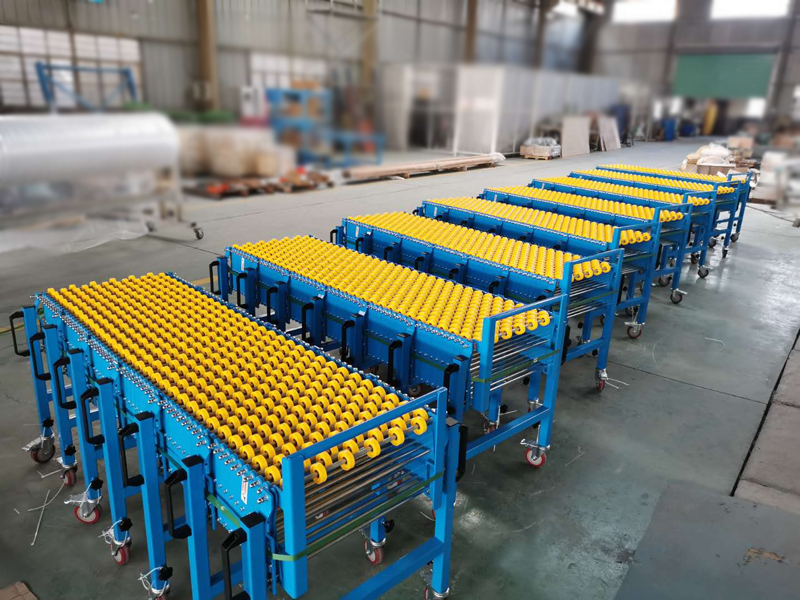
The Flexible Expandable Gravity Skate Wheel Conveyor is a lightweight, portable solution for handling cartons, boxes, parcels, and other flat-bottom packages. Its expandable scissor frame can extend, retract, and curve to adapt to changing material handling layouts.
Available with galvanized steel or plastic skate wheels, adjustable-height supports, and lockable swivel casters, this non-powered conveyor is ideal for warehouses, packing stations, logistics centers, and temporary loading or unloading operations.
A flexible expandable skate wheel conveyor is a non-powered material handling conveyor that uses freely rotating skate wheels to move goods by gravity or manual pushing.
The conveyor features an expandable scissor frame that can be extended or retracted according to the required conveying distance. It can also be arranged in straight or curved layouts to adapt to different work areas.
Height-adjustable support legs allow the conveyor to connect with packing stations, worktables, loading areas, and other conveyor equipment. Swivel casters with brakes make it easy to move, position, and secure the conveyor.
The skate wheel is the core conveying component. Depending on the application, the conveyor can be equipped with galvanized steel or plastic skate wheels. Its lightweight and flexible structure makes it particularly suitable for cartons, boxes, parcels, and other products with flat, rigid bottoms.
The expandable scissor frame provides an expansion ratio of approximately 1:3. For example, a conveyor with an extended length of around 3 meters can retract to approximately 1 meter.
The conveyor can be extended during operation and retracted when not in use, reducing occupied floor space in warehouses and work areas.
The skate wheels rotate freely, allowing goods to move by gravity or manual pushing without requiring an electric drive.
The non-powered design provides a simple solution for temporary conveying, carton transfer, packing, and loading operations.
The expandable frame can bend and change direction according to the available workspace.
It can be configured into straight or curved conveying routes, while multiple conveyor units can be connected when a longer conveying distance is required.
Swivel casters allow operators to move and reposition the conveyor between different work areas.
Once positioned, the caster brakes help secure the conveyor during operation. Adjustable support legs also allow the working height to be matched with other equipment or workstations.
Compared with roller-type flexible conveyors, the skate wheel design provides a lighter conveying structure.
This makes the conveyor particularly suitable for operations where equipment needs to be frequently moved, repositioned, extended, or stored.
The skate wheel design provides multiple contact points for cartons and packages. Depending on the selected wheel and bearing configuration, goods can move smoothly with relatively low pushing force.
For best conveying performance, packages should have a flat and sufficiently rigid bottom.
Parameter | Specification |
|---|---|
Conveyor Type | Flexible Expandable Skate Wheel Conveyor |
Skate Wheel Diameter | 38 mm / 48 mm |
Conveying Width | 450 mm / 500 mm / 600 mm |
Unit Length (Retracted / Extended) | 350–450 mm / 1000–1250 mm |
Expansion Ratio | Approx. 1:3 |
Height Adjustment | 460–630 mm / 550–820 mm / 650–1020 mm / 750–1150 mm and other options |
Load Capacity per Unit | Approx. 50–70 kg/unit |
Unit Weight | Approx. 35 kg for 500 mm width |
Skate Wheel Material | Galvanized Steel / Plastic |
Drive Mode | Non-powered / Gravity / Manual |
Layout | Straight / Curved |
Mobility | Swivel Casters with Brakes |
Suitable Goods | Cartons, Boxes, Parcels and Flat-Bottom Packages |
38 mm and 48 mm skate wheel diameters are available. The 48 mm wheel is a commonly used option for flexible expandable conveyor applications.
Specifications may vary according to conveyor configuration and application requirements.
The performance of a flexible skate wheel conveyor depends not only on the wheel material but also on the internal bearing structure. RONWIN offers galvanized steel and plastic skate wheel options for different load, mobility, durability, and operating requirements.
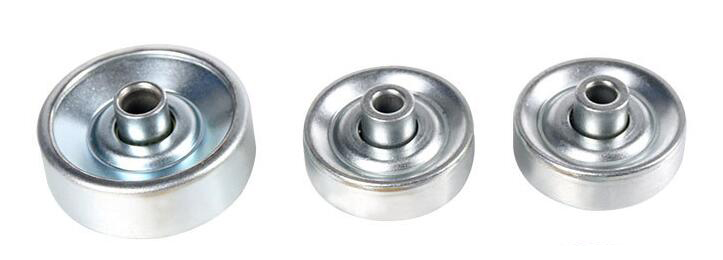
The galvanized steel skate wheel uses a durable metal wheel body with an internal steel-ball structure. It is designed for applications where impact resistance, durability, and long service life are important.
Key Characteristics:
Starting Torque: Relatively higher due to greater internal rolling resistance compared with precision-bearing configurations.
Load Performance: Suitable for general carton and package handling. Actual capacity depends on the wheel and bearing configuration.
Durability: Excellent resistance to impact, wear, and frequent handling.
Temperature & UV Resistance: The metal wheel body is less susceptible to ageing caused by sunlight or temperature changes.
Corrosion Resistance: The galvanized surface provides additional rust protection under normal operating conditions.
Best For: Frequent handling, loading and unloading areas, demanding working conditions, and applications where durability is a priority.
Figure 1: Galvanized steel skate wheel; 38 mm and 48 mm diameters are available.
The plastic skate wheel uses an engineering-plastic wheel body and can be equipped with precision deep-groove ball bearings, such as 608-series bearings.
This configuration provides low rolling resistance and smooth movement for cartons, parcels, and other packages.
Key Characteristics:
Starting Torque: Low rolling resistance allows packages to start moving with relatively little pushing force.
Load Performance: In configurations using precision deep-groove ball bearings, the bearing structure can provide strong radial load performance compared with simpler steel-ball wheel structures.
Smooth Operation: Precision bearings provide smooth and consistent wheel rotation.
Package Protection: The plastic contact surface is gentler on cartons and packaging materials.
Lightweight: Plastic skate wheels reduce overall conveyor weight, making the conveyor easier to reposition.
Durability: Suitable for normal indoor material handling. Long-term exposure to strong UV light, extreme temperatures, or certain chemicals may affect the service life of engineering plastics.
Best For: Indoor warehouses, parcel handling, packing stations, and applications requiring lightweight and smooth movement.
Figure 2: Yellow, blue, and gray plastic skate wheel options are available.
Comparison | Galvanized Steel Skate Wheel | Plastic Skate Wheel |
|---|---|---|
Internal Structure | Steel-ball structure | Precision deep-groove ball bearings |
Starting Resistance | Relatively higher | Lower |
Running Smoothness | Good | Excellent |
Durability | Excellent | Good for normal indoor use |
Impact Resistance | Higher | Moderate |
Package Protection | Good | Better for cartons and packaging |
Conveyor Weight | Heavier | Lighter |
Corrosion Resistance | Galvanized surface protection | Naturally corrosion-resistant |
UV & Temperature Resistance | Better | More sensitive to prolonged exposure |
Recommended Use | Demanding handling and loading areas | Indoor carton and parcel handling |
Selection Tip: Choose galvanized steel skate wheels when durability and impact resistance are the main priorities. Choose plastic skate wheels with precision bearings when low starting resistance, lightweight operation, and smooth carton handling are more important.
The flexible expandable skate wheel conveyor is particularly suitable for light-to-medium-duty packages with flat, rigid bottoms and for work areas where conveying routes frequently change.
Move cartons and boxes between storage, picking, packing, and dispatch areas without installing a permanent conveyor line.
Use the conveyor between picking, sorting, packing, and dispatch stations where layouts may change according to order volume and workflow.
Extend the conveyor toward temporary loading or unloading points to reduce manual carrying distances. After use, retract and move it away to free up floor space.
Use the flexible skate wheel conveyor as a temporary connection between packing stations, worktables, and existing material handling equipment.
The portable design allows the conveyor to be repositioned between sorting, transfer, packing, and dispatch areas as operational requirements change.
Select the conveyor configuration according to your package dimensions, weight, operating environment, required conveying distance, and frequency of movement.
For smooth indoor carton and parcel handling:
Plastic skate wheels with precision bearings provide low rolling resistance, smooth movement, and a lightweight conveyor structure.
For demanding or impact-prone working conditions:
Galvanized steel skate wheels provide greater durability and impact resistance, making them suitable for frequent loading, unloading, and material handling.
For frequently repositioned conveyors:
A plastic skate wheel configuration can reduce overall conveyor weight and make the unit easier to move between work areas.
Also consider the required conveyor width, expanded length, working height, and package dimensions before selecting the final configuration.
The model number identifies the main conveyor configuration.
Example Model: FC-48-500×4
Code | Meaning |
|---|---|
FC | FC-series flexible skate wheel conveyor |
48 | Skate wheel diameter: 48 mm |
500 | Conveying surface width: 500 mm |
×4 | 4 connected conveyor units |
For example, if each conveyor unit extends to approximately 1250 mm, four connected units provide an approximate total extended length of:
4 × 1250 mm = 5000 mm
Final retracted and extended dimensions should always be confirmed according to the selected conveyor configuration.
A flexible skate wheel conveyor is a portable, non-powered conveyor with an expandable scissor frame and multiple freely rotating skate wheels. It can extend, retract, and curve according to changing material handling requirements.
It is best suited for cartons, boxes, parcels, totes, and other light-to-medium-duty products with flat and sufficiently rigid bottoms.
No. A gravity skate wheel conveyor uses gravity or manual pushing to move goods and does not require a motor.
Choose galvanized steel skate wheels when durability and impact resistance are priorities. Plastic skate wheels with precision bearings are suitable when lightweight construction, low rolling resistance, and smooth carton handling are more important.
A skate wheel conveyor is generally lighter and easier to reposition, making it suitable for cartons, parcels, and frequently changing layouts. A roller conveyor provides a larger contact surface and is generally better suited to heavier loads or applications requiring greater conveying stability.
Yes. Multiple units can be connected to increase the total conveying distance according to the required layout and working area.
Yes. Conveyor width, expanded length, working height, skate wheel diameter, wheel material, and the number of conveyor units can be selected according to the application.