|
FD
RONWIN
The Motorized Flexible Expandable Roller Conveyor combines powered roller conveying with an extendable, retractable, and mobile frame for automated carton and box handling. Its flexible scissor structure allows the conveyor length and direction to be adjusted according to changing material handling requirements.
With powered rollers, adjustable conveying speed, height-adjustable supports, and lockable casters, this expandable roller conveyor is ideal for warehouses, logistics centers, packing lines, parcel handling, and temporary production or loading operations where both mobility and automated conveying are required.
A motorized flexible expandable roller conveyor is a powered material handling system that uses driven rollers to transport cartons, boxes, totes, and other suitable unit loads automatically.
Unlike a fixed powered roller conveyor, the expandable scissor frame allows the conveyor length to be extended or retracted according to the required working distance. The conveyor can also be arranged into straight or curved layouts to match different work areas.
The rollers are powered through motorized drive sections and belt transmission systems, enabling continuous and controlled product movement without manual pushing.
This combination of powered conveying, flexible layout, and mobile construction makes the conveyor especially suitable for applications where material flow, conveying distance, or workstation layout changes frequently.
The flexible expandable frame provides an extension ratio of up to approximately 1:3.
The conveyor can be extended during operation and retracted when not in use, reducing the amount of permanently occupied floor space compared with a fixed conveyor system.
Motorized rollers move cartons and packages automatically along the conveyor, reducing the need for manual pushing.
This makes the conveyor suitable for continuous or higher-frequency material handling operations where stable conveying speed and consistent product flow are required.
The expandable conveyor body can be adjusted according to the available workspace and material flow direction.
It can be arranged into straight or curved conveying routes and repositioned as production, packing, or loading requirements change.
The conveyor support legs can be adjusted to match different packing stations, worktables, loading areas, and existing conveyor systems.
This makes it easier to integrate the flexible conveyor into temporary or existing material handling layouts.
Swivel casters make the conveyor easy to move between different work areas.
Once the required position is reached, the casters can be locked to help stabilize the conveyor during operation.
The conveyor uses a modular structure that allows multiple sections to be configured according to the required total conveying length.
This makes it suitable for both short transfer applications and longer temporary conveying lines.
Depending on the selected control configuration, the conveyor can operate at a fixed speed or use variable-speed control.
Adjustable speed allows the conveying rate to be matched with upstream and downstream packing, sorting, or production processes.
Parameter | Specification |
|---|---|
Conveyor Type | Motorized Flexible Expandable Roller Conveyor |
Roller Diameter | 50 mm standard |
Conveying Length | From approx. 2000 mm; configurable according to application |
Recommended Powered Section Length | Up to approx. 10 m per powered section |
Conveying Width | 450 mm / 500 mm / 600 mm |
Custom Width | Available according to requirements |
Conveying Height | Approx. 500–1000 mm |
Line Speed | Approx. 10–40 m/min |
Motor Power | Approx. 90–120 W per section |
Load Capacity | Approx. 70 kg per section |
Roller Material | Zinc-plated carbon steel / stainless steel / rubber-coated |
Speed Control | Fixed Speed / Variable Speed |
Layout | Straight / Curved |
Mobility | Lockable Swivel Casters |
Specifications may vary according to conveyor length, load, drive method, motor configuration, roller material, and operating requirements.
Feature | Motorized Flexible Roller Conveyor | Fixed Roller Conveyor |
|---|---|---|
Conveyor Length | Expandable and retractable | Fixed |
Mobility | Portable with casters | Stationary |
Layout | Straight or curved | Predetermined layout |
Installation | Flexible deployment | Permanent installation |
Floor Space | Retracts when not required | Permanently occupies space |
Conveying | Powered | Powered or gravity |
Repositioning | Easy | Limited |
Best For | Changing and temporary workflows | Permanent production layouts |
A motorized flexible roller conveyor is generally better suited to warehouses, packing areas, and temporary production layouts where conveyor position or length changes frequently.
A fixed roller conveyor is more suitable when the material flow route is permanent and high-volume conveying takes place continuously in the same location.
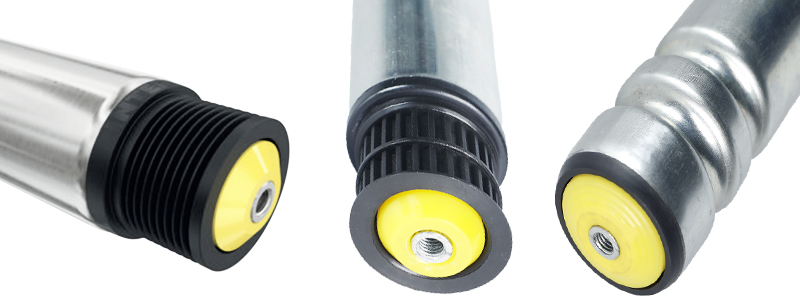
The powered flexible expandable roller conveyor can use different roller and belt drive configurations according to the required load, speed, transmission stability, and operating environment.
(figure 1. Three types of standard rollers: Poly-v pulley driven roller, Toothed pulley driven roller, Grooved belt driven roller)
An O-belt, also known as a round belt, transmits power between rollers through grooves in the roller surface.
This drive method has a relatively simple structure and is commonly used for light-to-medium-duty carton and package conveying.
Advantages:
Simple transmission structure
Smooth operation
Relatively low noise
Easy replacement
Suitable for many standard carton handling applications
Recommended For: General warehouse, packing, carton, and parcel conveying.
A Poly-V belt uses multiple longitudinal ribs to increase the contact area between the belt and the roller pulley.
This allows the drive system to transmit higher torque than many basic round-belt configurations while maintaining smooth roller operation.
Advantages:
Greater belt-to-pulley contact area
Good torque transmission
Smooth operation
Suitable for medium-duty conveying
Stable performance at higher conveyor loads
Recommended For: Applications requiring greater conveying force and more consistent roller drive.
A synchronous or timing belt uses toothed engagement between the belt and pulley.
This positive-drive design reduces belt slip and provides more consistent transmission between driven rollers.
Advantages:
Positive belt engagement
Minimal transmission slip
Consistent speed transmission
Suitable for applications requiring higher transmission accuracy
Good torque capability
Recommended For: Applications where consistent roller speed and controlled transmission are important.
Feature | Timing Belt | Poly-V Belt | O-Belt |
|---|---|---|---|
Transmission Type | Positive toothed drive | Friction drive | Friction drive |
Slip Resistance | Excellent | Good | Moderate |
Speed Consistency | Excellent | Good | Good for general conveying |
Torque Capability | High | Medium to High | Light to Medium |
Structure | More precise | Compact | Simple |
Maintenance | Low to Moderate | Moderate | Easy replacement |
Typical Application | Controlled powered conveying | Medium-duty powered conveying | Carton and parcel handling |
The best drive method depends on load weight, conveyor length, conveying speed, required transmission stability, and operating conditions.
The motorized flexible conveyor can be configured with fixed-speed or variable-speed operation.
A fixed-speed conveyor operates at a preset conveying speed.
This configuration is suitable when cartons or packages need to move at a consistent rate and frequent speed adjustment is not required.
A variable-speed configuration allows the conveyor speed to be adjusted according to the material handling process.
Typical conveying speeds can range from approximately 10 to 40 m/min, depending on the final conveyor configuration.
Variable-speed control is particularly useful when the flexible conveyor needs to coordinate with packing lines, sorting stations, production equipment, or other conveyors operating at different speeds.
The powered flexible expandable roller conveyor is designed primarily for cartons, boxes, totes, and other unit loads that have sufficiently flat and stable conveying surfaces.
Use the conveyor for moving cartons between receiving, storage, packing, staging, and dispatch areas where conveying routes may change.
Powered conveying helps move parcels and cartons continuously between sorting, packing, temporary storage, and dispatch stations.
The adjustable length and powered rollers make the conveyor suitable for parcel handling operations where material flow changes according to order or shipment volume.
The conveyor can provide a flexible powered connection between production equipment, packing stations, inspection areas, and fixed conveyor sections.
Because the conveyor can be moved and reconfigured, it is useful when temporary conveying capacity is required without installing a permanent conveyor system.
The expandable conveyor can be extended toward loading positions and retracted when the area needs to be cleared for other operations.
The conveyor is particularly suitable for:
Cartons
Boxes
Totes
Cases
Packaged goods
Stable unit loads
Products should generally have a sufficiently flat and rigid bottom to maintain stable contact with the rollers.
Small, loose, flexible, or irregularly shaped goods should normally be placed in totes, trays, cartons, or other suitable carriers before conveying.
Choosing the correct conveyor configuration depends on the products being handled and the required material handling process.
Product Size and Weight
Confirm the carton or package dimensions and maximum load weight.
Required Conveyor Length
Measure the distance between loading, packing, sorting, or production points and determine the required expanded length.
Conveyor Width
Select the roller width according to the dimensions of the products being conveyed.
Working Height
Match the conveying height with existing conveyors, workstations, packing tables, or loading areas.
Conveying Speed
Choose fixed-speed operation for consistent material flow or variable-speed control when the conveying rate needs to match other processes.
Drive Method
Select O-belt, Poly-V belt, or timing belt transmission according to required load, torque, speed consistency, and application conditions.
Roller Material
Choose zinc-plated carbon steel for standard industrial applications, stainless steel where additional corrosion resistance is required, or rubber-coated rollers when greater surface grip or product protection is needed.
A motorized flexible roller conveyor is a powered conveyor with an expandable scissor frame and driven rollers. It can extend, retract, curve, and move between work areas while automatically conveying cartons and packages.
A powered flexible conveyor uses motor-driven rollers to move products automatically. A gravity flexible conveyor relies on gravity or manual pushing and does not contain a powered roller drive system.
Yes. Depending on the control configuration, the conveyor can operate at a fixed speed or with variable-speed control. Typical conveying speeds are approximately 10–40 m/min.
O-belt drives are suitable for many general carton handling applications. Poly-V belt systems provide stronger torque transmission, while timing belt systems are better suited to applications requiring more consistent and controlled transmission.
Yes. The flexible expandable frame allows the conveying route to be adjusted into straight or curved layouts according to the available workspace.
It is mainly designed for cartons, boxes, totes, cases, and other stable unit loads with flat or sufficiently rigid bottoms.
Yes. Conveyor width, expanded length, conveying height, roller material, motor configuration, speed control, and drive method can be selected according to the application.