
 |
FA
RONWIN
The Flexible Expandable Gravity Roller Conveyor is a non‑powered roller conveying device whose frame can be freely extended or retracted. It uses a scissor‑type expandable frame as the supporting structure and rollers as the conveying medium. Goods are moved by manual pushing or by gravity, with the rollers rotating freely to enable smooth transport. The equipment has no built‑in drive source and belongs to the category of non‑motorised conveying equipment, serving as an important flexible link and auxiliary tool in logistics and warehousing systems.
Its core structure comprises: an expandable scissor‑type frame assembly, conveying rollers, height‑adjustable support legs, and swivel castors with brakes. The unit can be freely steered, adjusted to any angle, and configured as straight or curved sections as required, making it adaptable to various complex working environments.
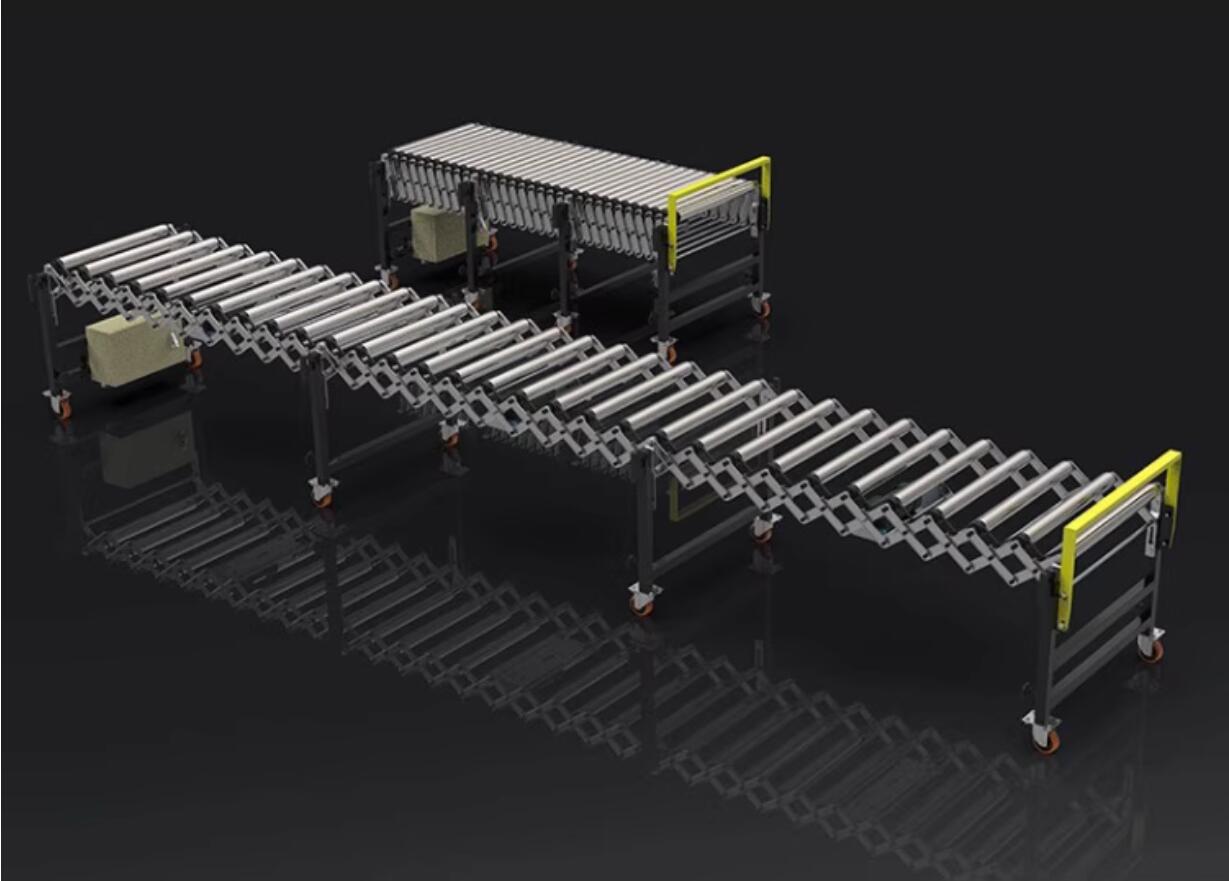
(Figure 1 Schematic diagram of the flexible expandable gravity roller conveyor – comparison of retracted and extended states)
The flexible expandable gravity roller conveyor offers the following significant advantages.
The expansion ratio of each section can reach 1:3, meaning the ratio between the fully extended length and the fully retracted length is 3:1. During operation, it can be extended to its full length to meet conveying needs; when not in use, it can be retracted to greatly reduce floor space, effectively increasing usable space by about twice – particularly suitable for workplaces with limited area.
The unit can be freely steered and its conveying route can be flexibly changed, with a maximum steering angle of up to 180°. The support legs are height‑adjustable, allowing the conveyor to be set horizontally or on an incline to meet different docking height requirements.
Equipped with silent swivel castors with brakes at the bottom, the conveyor can be quickly moved to any desired position and securely fixed. The extended length can be limited as needed. The equipment can be rearranged at any time according to operational requirements, enabling an efficient “deploy when needed, store when done” working mode.
The equipment has no motor drive, transmission devices or electrical control systems; it consists essentially of the frame and rollers. It offers the advantages of low cost, simple structure, easy maintenance and reliable operation, with extremely low long‑term maintenance expenses.
Depending on the type of goods to be conveyed, the rotating elements can be configured as single‑row or double‑row rollers. Roller materials include carbon steel galvanised, stainless steel, aluminium alloy, rubber‑coated, PVC, and more, to suit different conveying requirements.
The conveyor can be flexibly combined with multiple roller lines and other types of conveying equipment, serving as a flexible interface in logistics systems to quickly build a complete operational conveying line.
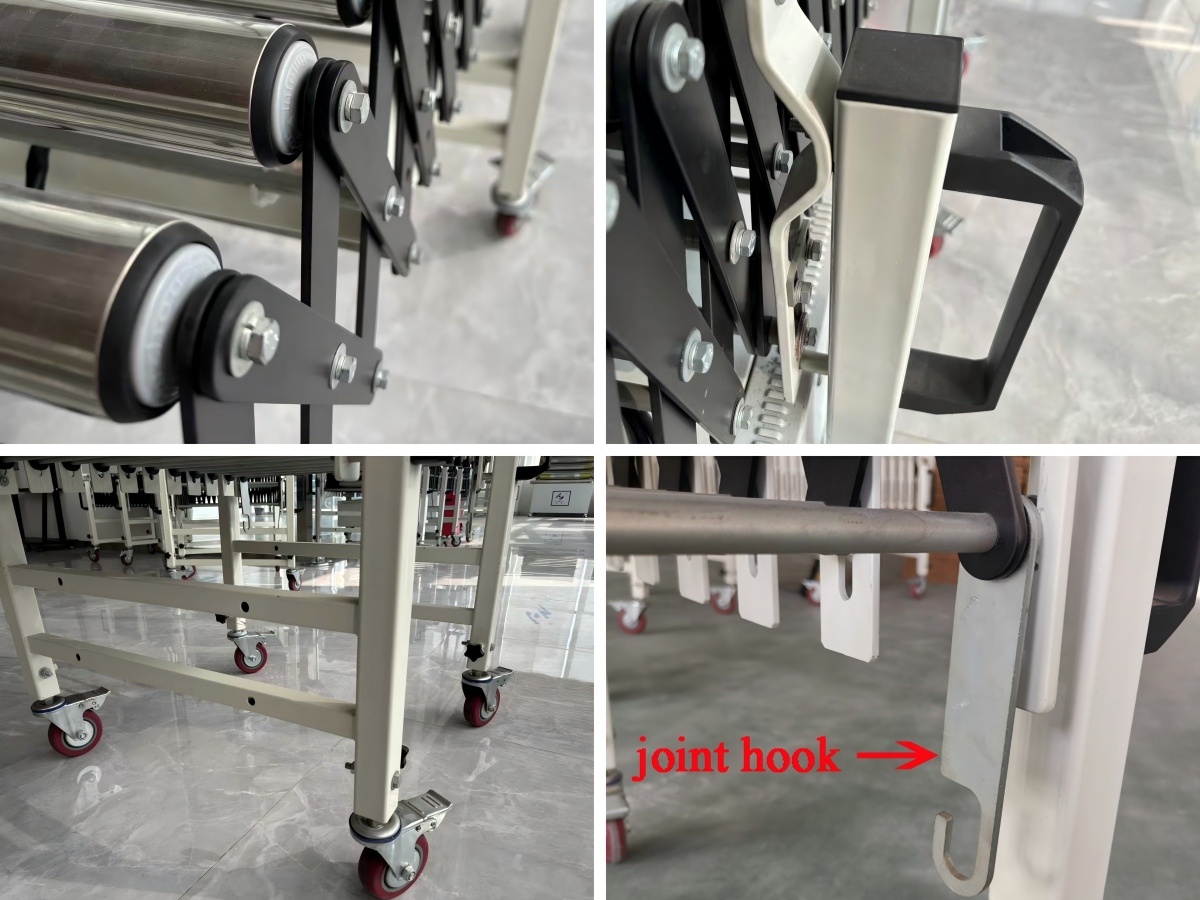
(Figure 2 Schematic diagram of the flexible expandable gravity roller conveyor – rollers, sciccsors, knobs, legs, carstors and hooks)
Common technical specifications of the flexible expandable gravity roller conveyor are as follows.
| Parameter | Specification Range |
|---|---|
| Expansion ratio | 1:3 (ratio of fully extended to fully retracted section length) |
| Maximum steering angle | Up to 180° |
| Conveying media | Single‑row rollers, double‑row rollers |
| Roller diameter | 50 mm (commonly used); 60 mm optional |
| Roller materials | Carbon steel galvanised rollers, stainless steel rollers, PVC rollers, aluminium alloy rollers, rubber‑coated rollers, etc. |
| Conveyor width | 450 mm, 500 mm, 600 mm, etc. |
| Section length | 400 mm – 1120 mm (for 50 mm diameter rollers) |
| Support leg height | Conventional adjustment range 650 mm – 950 mm |
| Load capacity per section | 70 kg (with 50 mm diameter rollers) |
| Total load capacity when fully extended | Approx. 100 kg (under no‑impact load conditions) |
| Turning radius | Standard inner turning radii: 600 mm, 900 mm, 1200 mm, etc. |
| Section composition | At least two sections per unit, with one set of scissor as one section |
| Aspect | Flexible Expandable Gravity Roller Conveyor | Fixed Roller Conveyor |
|---|---|---|
| Installation | Mobile, equipped with castors for free movement | Fixed, bolted permanently to the floor |
| Space adaptability | Length adjustable with 1:3 expansion ratio; retracts to save space when not in use | Fixed length, non‑adjustable, occupies permanent space |
| Directional flexibility | Freely steerable, up to 180° turning angle | Fixed direction; turning requires dedicated curved sections |
| Height adjustment | Support legs adjustable, allowing inclined or sloping sections | Fixed height, non‑adjustable |
| Deployment efficiency | Quick to extend and retract; operable by one person; highly manoeuvrable | Requires professional installation and commissioning; immovable |
| Power source | Non‑powered; relies on manual pushing or gravity | Can be non‑powered or optionally motor‑driven |
| Typical applications | Temporary conveying, loading/unloading, space‑constrained areas, frequent layout changes | Fixed production lines, long‑term stable conveying routes |
| Load capacity | Section capacity 70 kg; total capacity approx. 100 kg when fully extended | Higher load capacity; can be designed for heavier loads as required |
| Cost structure | Simple construction; lower purchase and maintenance costs | Depends on configuration; powered versions are more expensive |
Comparison summary: The flexible expandable gravity roller conveyor excels in flexibility, making it ideal for frequently changing workplaces, limited spaces, and rapid deployment scenarios. The fixed roller conveyor, on the other hand, offers advantages in long‑term stable operation, heavy‑load conveying, and integration with automation systems. The two types often complement each other in practical applications.
The flexible expandable gravity roller conveyor is widely used for conveying finished cartons and totes in various industries. Typical applications include:
Loading and unloading operations: Rapid loading/unloading in workshops, warehouses, and freight yards; can be extended into truck trailers to reduce manual carrying distances.
Logistics and distribution: Handling and temporary storage in express sorting centres, freight stations, and container loading areas.
Production and packaging lines: As temporary or auxiliary conveying equipment alongside production lines, linking different workstations.
E‑commerce warehousing: Flexibly responding to fluctuating order volumes to enable agile warehousing operations.
Industries served: Electronics, beverages and food, packaging and printing, machinery manufacturing, light industry and textiles, tobacco, chemical and pharmaceutical, rubber and plastic products, automotive and motorcycle parts, etc.
FA-single-row rollers series
50-roller diameter
500-transportation surface width
×4-four sections
FB-double-row rollers series
50-roller diameter
800-transportation surface width
×5-five sections
The flexible expandable gravity roller conveyor is a lightweight, flexible conveying device that combines easy mobility, expandable storage, free steering, and economic reliability. It operates without electrical power, has a simple structure, and is easy to maintain. It is an ideal solution for bridging fixed equipment and manual handling operations in logistics and warehousing systems. Particularly suitable for scenarios that require frequent changes in work locations, flexible conveying routes, and cost‑sensitive investments, this equipment effectively improves loading/unloading and handling efficiency, reduces manual labour intensity, and serves as an indispensable tool for modern flexible logistics operations.


