Views: 0 Author: Site Editor Publish Time: 2025-11-10 Origin: Site

Imagine a warehouse where the layout changes daily, and efficiency is key. How do you handle such dynamic environments? Flexible conveyors are the answer. These systems adapt seamlessly to shifting needs, ensuring smooth operations. In this article, you'll learn about the types of flexible conveyor models and their benefits for warehouses. Explore how these conveyors enhance adaptability and streamline processes in ever-changing settings.
Flexible conveyor models stand out in warehouse environments due to their unique features that support dynamic operations. These conveyors are designed to adapt quickly to changing workflows, making them essential in modern material handling.
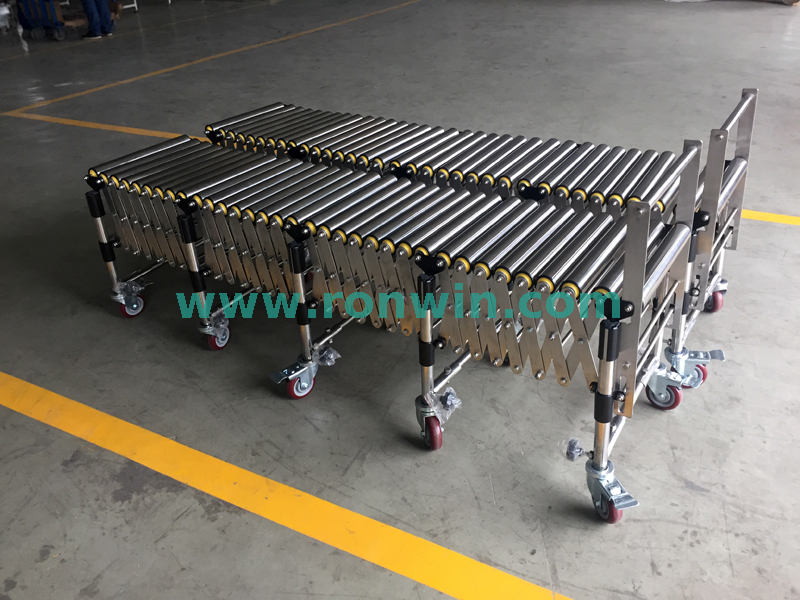
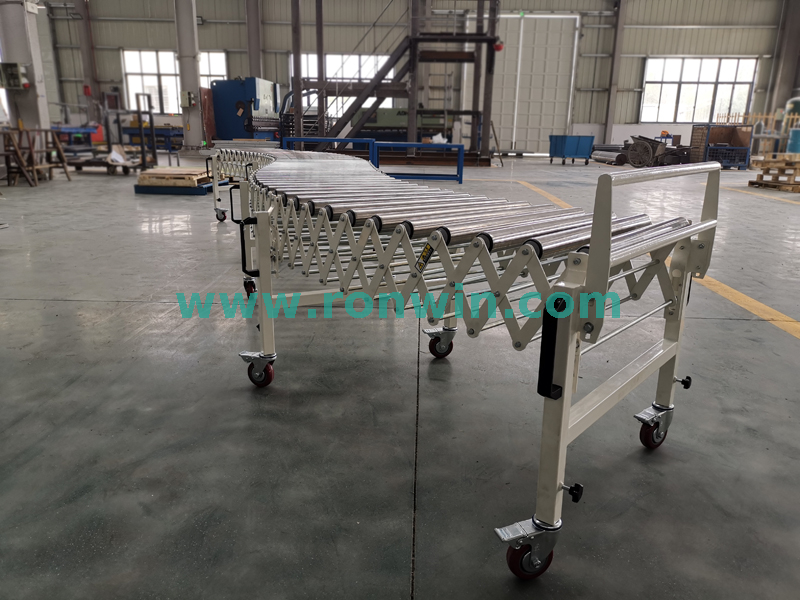
One of the most notable features of flexible conveyor systems is their adjustability. They can expand, contract, and curve around obstacles, allowing easy customization of conveyor length and shape. This flexibility is especially valuable in warehouses where layouts frequently change or temporary setups are needed. Many flex conveyor systems come with sturdy caster wheels, enabling effortless movement across the floor. Operators can reposition conveyors within minutes, enhancing workflow adaptability without requiring permanent installation.
Powered flex conveyors further improve productivity by offering motorized rollers that maintain consistent product flow without manual pushing. Models like the BESTFLEX powered roller conveyor combine flexibility with motorized operation, making loading and unloading tasks faster and less labor-intensive.
Flexible conveyor models excel in optimizing warehouse space. Their expandable roller or skate wheel designs allow conveyors to retract when not in use, freeing valuable floor space for other activities. This is particularly beneficial in facilities with limited room or where temporary conveyor lines are frequently set up and dismantled.
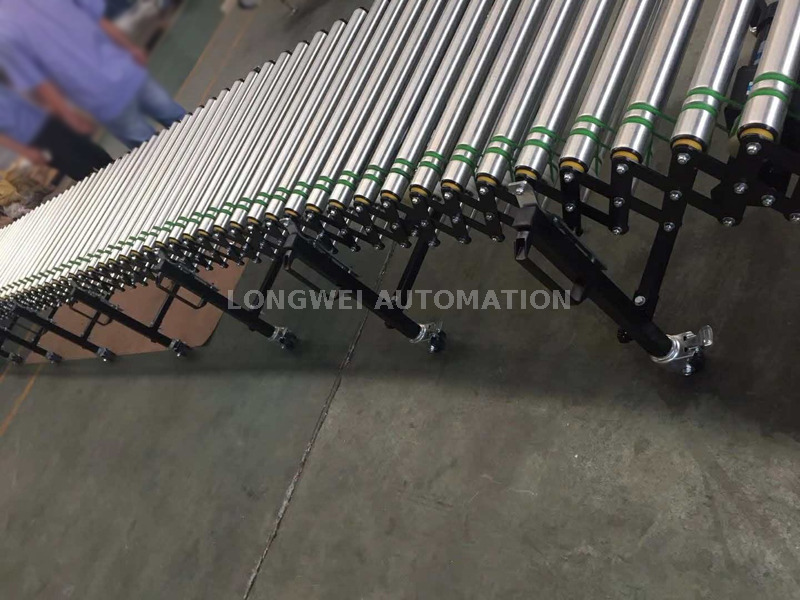
Expandable conveyor systems, such as flexible roller conveyors and expandable roller conveyors, can be compacted into a small footprint for storage. When needed, they extend to accommodate high-volume periods or special projects. This space-saving capability helps warehouses maintain an organized environment while maximizing operational capacity.
Integrating flexible conveyor models into existing warehouse conveyor networks is straightforward. Their modular construction and adjustable heights enable alignment with fixed conveyor lines, loading docks, or sorting equipment. Flexible conveyor belts and flexible roller conveyors can connect smoothly to other conveyor types, ensuring continuous material flow.
For example, flexible screw conveyors and flexible screw auger conveyors can be incorporated into bulk handling systems to complement roller or belt conveyors. Additionally, conveyors like the Nestaflex conveyor offer customizable configurations that fit diverse operational layouts.
This interoperability reduces installation time and costs, allowing warehouses to upgrade or expand their material handling capabilities without overhauling entire systems.
Tip: When selecting flexible conveyor models, prioritize systems with adjustable height and modular connectivity to ensure seamless integration and maximize operational flexibility.
Selecting the right flexible conveyor system requires understanding how each model performs under different operational demands. Longwei offers a comprehensive lineup of flexible conveyors designed to handle a variety of loads, materials, and workflow patterns.
Below, the models are grouped into four main categories, with specific distinctions among each type.
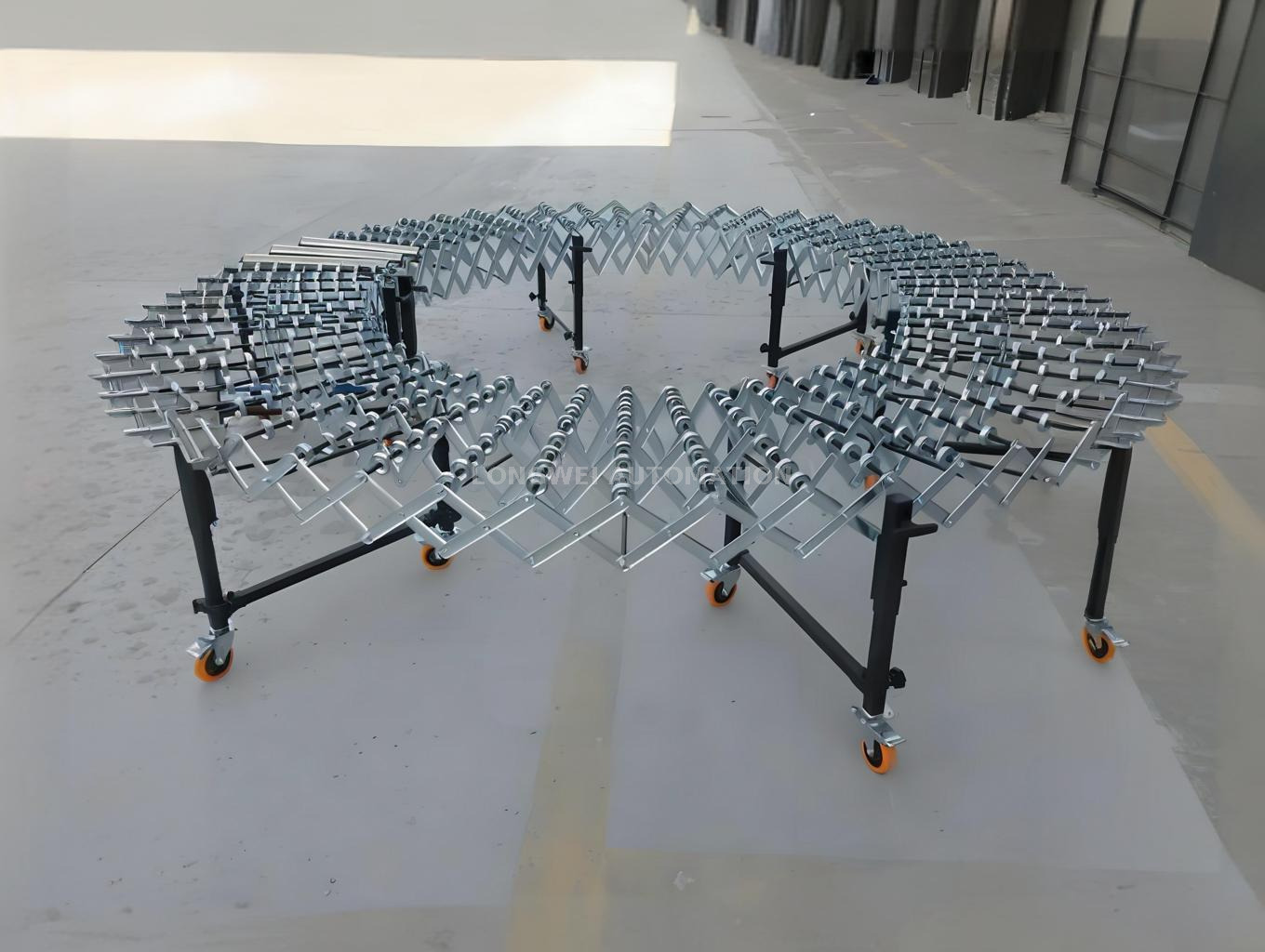
360° Rotation Flexible Expandable Gravity Conveyor
Doble-Row Gravity Roller Conveyor
Gravity Flexble Extendable Roller Conveyor
Longwei’s gravity flexible roller conveyors are built for heavy-duty, high-efficiency material handling. These models rely on gravity flow and feature precision-engineered rollers on a robust steel structure that expands, contracts, and curves easily.
Key models include:
360° Rotation Flexible Expandable Gravity Roller Conveyor –
Features roller diameters of 38 mm / 50 mm / 60 mm and widths from 450 mm to 800 mm.
Each unit supports up to 100 kg (non-impact load).
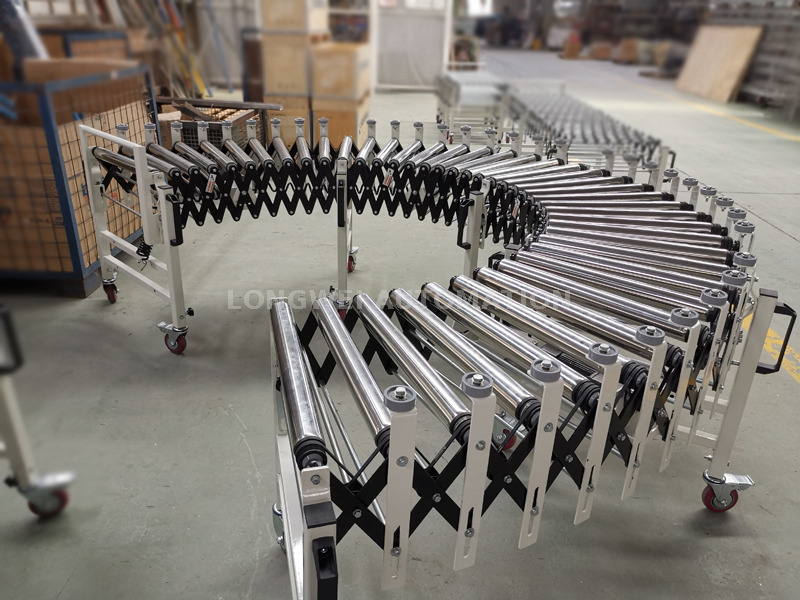
Its unique 360° rotation design enables smooth directional changes, ideal for dock and sorting areas with tight spaces.
Flexible Expandable Double-Row Gravity Roller Conveyor –
Designed for wider or heavier loads, the double-row structure offers greater stability and load capacity.
Suitable for bulky items or high-volume handling where extra support is required.
Gravity Flexible Extendable Roller Conveyor –
A cost-efficient standard model emphasizing expandability and portability.
Ideal for loading/unloading operations where powered drive is not necessary.
Gravity Roller Advantages:
Load capacity up to 100 kg per meter.
Expandable and fully curved layout for maximum flexibility.
Height adjustable between 800–1000 mm for system integration.
No power requirement – simple, durable, and maintenance-friendly.
Flexible O-belt Motor Roller Conveyor
Motorised Poly-v Roller Conveyor
Motorized Flexible Toothed Roller Conveyor
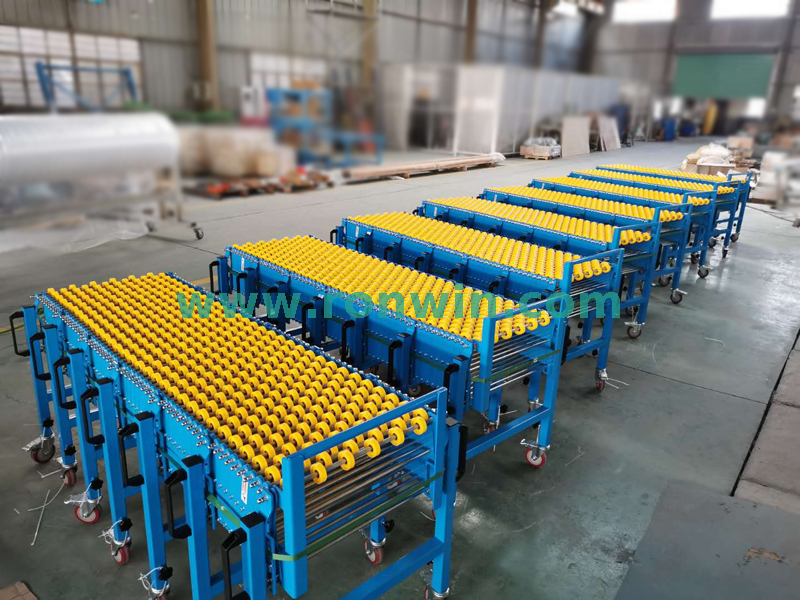
For powered, controlled movement and consistent product flow, Longwei offers several motorized flexible roller systems. Each model uses a specific drive method suited to different speed, torque, and efficiency requirements.
Key models include:
Flexible Expandable O-belt Motor Drive Roller Conveyor –
Uses a reliable O-belt drive system to link rollers.
Standard speed: 25 m/min, adjustable up to 35 m/min with control cabinet.
Roller diameter: 50 mm; unit load: 100 kg.
Ideal for medium-duty applications requiring stable powered movement.
Motorised Flexible Expandable Poly-V Belt Drive Roller Conveyor –
Employs a Poly-V belt drive for smoother power transmission and higher friction grip.
Ensures quiet operation and longer service life.
Suitable for high-volume, continuous material flow where gentle start-stop control is needed.
Motorized Flexible Expandable Toothed Belt Drive Roller Conveyor –
Uses a toothed (timing) belt drive for precise synchronization and high-torque performance.
Ideal for operations demanding speed consistency and minimal slippage.
Motor-Drive Advantages:
Power-assisted transport for heavy or long-distance runs.
Adjustable speed range 10–35 m/min (model dependent).
Reduced manual labor and improved ergonomic handling.
Easy integration with fixed lines or automation controls.
Steel Skate Wheel Conveyor
 Plastic Skate Wheel Conveyor
Longwei’s flexible skate wheel conveyors deliver exceptional portability and are designed for light to medium loads with flat bottoms. They’re a preferred choice for operations requiring frequent layout changes and quick deployment.
Key models include:
Flexible Extendable Steel Skate Wheel Conveyor –
Equipped with steel skate wheels, offering higher durability and load capacity.
Excellent for moderate loads and long service life in industrial environments.
Gravity Flexible Expandable Plastic Skate Wheel Conveyor –
Lightweight and corrosion-resistant plastic skate wheels provide smoother handling for delicate or lightweight items.
Ideal for packaging, e-commerce, and temporary setups.
Skate Wheel Advantages:
Highly portable and space-saving.
Best suited for light packages (≤ 50 kg/m).
Curves and extends easily around obstacles.
Requires minimal setup time and no power connection.
| Category / Model | Drive Type | Load Capacity | Speed Range | Portability | Best For |
|---|---|---|---|---|---|
| 360° Rotation Gravity Roller | Gravity | ≤ 100 kg/m | Gravity flow | High | Tight spaces, curved paths, truck loading |
| Double-Row Gravity Roller | Gravity | ≤ 100 kg/m (per row) | Gravity flow | High | Bulky packages, high throughput |
| Gravity Extendable Roller | Gravity | ≤ 100 kg/m | Gravity flow | High | General loading/unloading |
| O-belt Motor Drive Roller | Powered (O-belt) | ≤ 100 kg/unit | 10–35 m/min | High | Medium-duty, consistent flow |
| Poly-V Belt Drive Roller | Powered (Poly-V) | ≤ 100 kg/unit | 10–35 m/min | High | Quiet, continuous, high-volume lines |
| Toothed Belt Drive Roller | Powered (Timing belt) | ≤ 100 kg/unit | 10–35 m/min | High | Precise, high-torque operations |
| Steel Skate Wheel | Gravity | ≤ 50 kg/m | Gravity flow | Very High | Light-medium goods, longer life |
| Plastic Skate Wheel | Gravity | ≤ 30 kg/m | Gravity flow | Very High | Light packages, gentle handling |
When selecting your flexible conveyor, consider these parameters:
Load weight and product base – Heavy or firm-bottom goods suit roller models; lighter or delicate items fit skate-wheel systems.
Power requirement – Choose motorized conveyors for long distances or level floors; gravity conveyors for simplicity and cost efficiency.
Operational environment – Use steel components for heavy-duty settings and plastic wheels for quieter, cleaner areas.
Layout flexibility – All models expand, contract, and curve, but 360° and double-row types offer the highest layout adaptability.
Tip: For warehouses requiring high versatility and fast setup, combine motorized flexible conveyors for main lines with gravity skate wheel conveyors for auxiliary or temporary tasks — ensuring continuous, efficient, and ergonomic flow across your entire operation.
Flexible conveyors play a vital role in optimizing warehouse operations. Their adaptability and mobility make them perfect for various applications, especially where space and workflow demands change frequently. Let’s explore key warehouse uses for flexible conveyor models.
Flexible conveyor systems are invaluable for loading and unloading trucks. Their expandable and bendable frames allow conveyors to extend directly into truck trailers, bridging the gap between vehicles and warehouse floors. This reduces manual handling and speeds up material transfer.
Powered flex conveyors, like flexible powered roller conveyors, maintain a steady flow of packages without manual pushing. This capability improves ergonomics and reduces worker fatigue during loading dock operations. Additionally, flexible screw conveyors can assist in moving bulk materials efficiently when integrated into loading processes.
For example, an expandable roller conveyor can be quickly extended to match various truck sizes. Once unloading finishes, it retracts for easy storage, saving valuable dock space.
Warehouses often face seasonal spikes or temporary projects requiring rapid reconfiguration. Flexible conveyors shine here due to their quick setup and portability. They can be moved, expanded, or contracted to fit temporary layouts without permanent installation.
Expandability allows the system to adapt to fluctuating volumes, such as holiday rushes or promotional campaigns. Nestaflex conveyors and other flexi conveyors offer modular designs that support these dynamic needs. After peak periods, these conveyors collapse for compact storage, freeing floor space.
Temporary packing stations, cross-docking lines, or event setups benefit greatly from flexible conveyor belts and flexible roller conveyors, which can be deployed and dismantled swiftly.
Cross-docking demands fast, efficient product transfers between inbound and outbound shipments. Flexible conveyor models provide the agility to create temporary or semi-permanent pathways between docks and sorting areas.
Using flexible roller conveyors or flexible skate wheel conveyors, warehouses can configure flow paths that adapt to changing shipment patterns. Powered flex conveyors enhance throughput by automating package movement, while flexible screw auger conveyors handle bulk items where needed.
This adaptability reduces bottlenecks and supports just-in-time inventory management by enabling quick realignment of conveyor routes.
Tip: For loading docks and cross-docking, choose flexible conveyor systems with powered rollers and adjustable lengths to maximize efficiency and reduce manual labor during peak operations.
Selecting the ideal flexible conveyor system can greatly impact your warehouse’s efficiency and workflow adaptability. To make an informed choice, it’s essential to evaluate your specific operational needs, including load capacity, available space, and environmental conditions.
Start by understanding the weight and size of the items your warehouse handles regularly. Flexible conveyor models vary widely in load capacity. For example, flexible roller conveyors typically support between 80 to 100 kg per meter, making them suitable for medium to heavy packages. Powered flex conveyors offer added strength and consistent movement for heavier loads, ideal for loading docks and high-volume operations.
If your operation involves bulk materials, consider flexible screw conveyors or flexible screw auger conveyors, which handle granular or powdered goods efficiently. For lighter packages, flexible skate wheel conveyors or flexible conveyor belts might suffice, providing gentle handling without compromising speed.
Be sure to check the maximum load ratings of expandable conveyor systems to avoid overloading, which can cause premature wear or operational failures.
Warehouse layouts often change, and space is at a premium. Flexible conveyors shine in these environments due to their expandable and retractable designs. Expandable roller conveyors and nestaflex conveyors can contract to a compact size when not in use, freeing up valuable floor space.
Measure the available area where the conveyor will operate and consider how often you’ll need to adjust its length or shape. Flexi conveyors with caster wheels provide excellent portability, allowing you to reposition equipment quickly without permanent installation.
Also, think about aisle widths and clearance heights. Adjustable height legs on many flexible conveyor models help align the system with existing equipment, ensuring smooth product transfer without creating bottlenecks.
Your warehouse environment plays a crucial role in conveyor selection. Factors like temperature, humidity, dust, and exposure to chemicals can affect conveyor durability and performance.
For harsh or corrosive environments, opt for flexible conveyor models constructed from stainless steel or coated with corrosion-resistant finishes. Flexible conveyor belts made from specialized materials can resist oils, greases, or extreme temperatures.
If your warehouse requires frequent cleaning or operates in food-grade settings, modular flexible conveyor belts with easy-to-clean surfaces are advisable.
Additionally, powered flex conveyors should have electrical components rated for your environment to ensure safety and reliability.
Tip: When choosing a flexible conveyor system, match the conveyor’s load capacity and design to your warehouse’s specific space and environmental conditions to maximize efficiency and equipment longevity.
Proper installation and maintenance of flexible conveyor models are crucial to ensure reliable performance and long service life in warehouse environments. Whether you choose flexible roller conveyors, powered flex conveyors, or flexible conveyor belts, following best practices will minimize downtime and maximize efficiency.
Site Preparation: Select a flat and stable floor area with enough clearance for full extension and operator access. Concrete floors are ideal, but sturdy plywood can work for temporary setups.
Positioning and Extension: Place the conveyor perpendicular to the direction of movement. Unlock telescoping sections and extend them evenly to the desired length. Avoid forcing sections beyond their limits to prevent damage.
Height Adjustment: Adjust support legs starting from the discharge end backward. This maintains the proper conveyor pitch and smooth product flow.
Caster Setup: Ensure casters are aligned perpendicular to conveyor movement. Lock brakes once the conveyor is in position to prevent unwanted movement during operation.
Electrical Connections: For powered flex conveyors, connect to a suitable power source following manufacturer specifications. Test the conveyor at low speed initially without load, then gradually increase speed while monitoring for smooth operation.
Integration: When connecting to fixed conveyor systems, match conveyor heights and minimize gaps. Use transition plates if necessary to ensure smooth product transfer.
Visual Inspections: Conduct weekly checks for worn rollers, loose bolts, and damaged belts. Replace components promptly to avoid operational issues.
Cleaning: Remove debris and dust regularly to prevent buildup that can hinder roller rotation or belt movement.
Lubrication: Apply lubricant to bearings and moving parts as recommended. Avoid over-lubrication, which may attract dirt.
Electrical Checks: Inspect wiring and connections monthly. Test emergency stop functions and sensors to ensure safety.
Caster Care: Check caster wheels for wear and ensure brakes function correctly.
Belt Tension: For flexible conveyor belts, verify and adjust belt tension monthly to maintain proper tracking and prevent slippage.
Conveyor Jamming: Often caused by product jams or misaligned rollers. Clear obstructions immediately and inspect rollers for damage.
Uneven Belt Tracking: Adjust belt tension and alignment. Inspect pulleys and rollers for wear or damage.
Power Failures: Check electrical supply, fuses, and wiring. Ensure motor brushes and drive belts are in good condition.
Unstable Conveyor Movement: Verify caster locks are engaged and support legs are properly adjusted.
Noise or Vibration: Inspect rollers and bearings for wear. Lubricate or replace parts as needed.
Regular maintenance and proper installation extend the life of your flexible conveyor system and keep warehouse operations running smoothly.
Tip: Schedule routine inspections and maintenance for your flexible conveyor system to prevent unexpected downtime and maintain optimal performance.
Flexible conveyors offer a compelling balance between initial investment and long-term operational benefits. When evaluating the cost-effectiveness and return on investment (ROI) of flexible conveyor models, it’s essential to consider several factors that impact your warehouse’s bottom line.
The upfront cost of flexible conveyor systems, such as expandable roller conveyors or powered flex conveyors, may be higher than simple fixed conveyors. However, their adaptability and reusability across multiple warehouse configurations provide significant value over time. Because flexible conveyor models can be expanded, contracted, and repositioned, you avoid the need for multiple fixed conveyor lines or costly layout renovations.
Investing in a high-quality flexible conveyor belt or a powered flex conveyor often results in reduced capital expenditures on permanent infrastructure. Additionally, models like the Nestaflex conveyor or flexible screw conveyors offer modular designs that can evolve with your warehouse needs, extending equipment life and delaying replacement costs.
Flexible conveyor systems help reduce labor expenses by automating and streamlining material movement. Powered flex conveyors, for instance, minimize manual pushing, decreasing worker fatigue and injury risk. This automation can translate into fewer staff required for loading, unloading, and sorting tasks.
Moreover, the portability of flex conveyor systems allows quick deployment in different areas without specialized installation crews. This flexibility cuts downtime and labor costs associated with setting up or modifying conveyor lines. As a result, warehouses can respond swiftly to demand fluctuations without hiring additional temporary workers.
Operational efficiency gains from flexible conveyors contribute directly to ROI. Their ability to adapt to changing workflows means fewer bottlenecks and smoother product flow. For example, expandable roller conveyors can adjust length to match truck sizes during loading, reducing idle time and speeding up turnaround.
Flexible conveyor belts and flexible roller conveyors integrate easily with existing systems, creating seamless material handling lines that boost throughput. This integration minimizes package handling errors and damage, lowering product loss and rework costs.
Furthermore, flexible screw conveyors and flexible screw auger conveyors efficiently handle bulk materials, improving processing speed in specialized operations. By enhancing workflow agility and equipment utilization, these conveyors maximize productivity and profitability.
Tip: Prioritize flexible conveyor models with powered operation and modular design to maximize ROI through labor savings and enhanced operational efficiency.
Flexible conveyor models offer significant benefits for warehouse operations, including adjustability, space-saving design, and ease of integration. Their adaptability enhances efficiency by accommodating changing workflows and reducing labor costs. For warehouses considering optimization, these conveyors provide a cost-effective solution with a compelling return on investment. Companies like Longwei offer innovative flexible conveyor systems that maximize operational capacity, streamline material handling, and deliver lasting value. Investing in such advanced systems ensures warehouses remain agile and competitive in dynamic environments.
A: Flexible conveyors (expandable/contractable systems) bring several key benefits:
They adapt quickly to shifting layouts—expand, contract, curve or retract—making them ideal for dynamic warehouse operations.
They optimise floor space: when not in use, they can collapse and be stored compactly.
Labour and ergonomic advantages: powered flexible roller models reduce manual pushing, boosting throughput and reducing fatigue.
Integration flexibility: they work alongside fixed lines, trucks/trailers, cross-docks, providing seamless material flow.
A: Flexible conveyor systems, like flex conveyor systems and powered flex conveyors, provide greater adaptability and mobility compared to fixed lines. They can expand, contract, and curve to fit changing layouts, offering a cost-effective solution for warehouses with fluctuating needs.
A: Flexible roller conveyors are ideal for heavy packages with firm bottoms, while flexible belt conveyors suit delicate or irregularly shaped items. Both types offer expandability and portability, but roller conveyors often have higher load capacities and powered options.
A: Powered flex conveyors are suitable for most environments, offering motorized operation for consistent product flow. However, consider environmental factors like temperature and humidity when selecting materials and electrical components to ensure optimal performance.
A: To select the correct model, consider:
Load weight and bottom surface: heavier loads with firm bottoms suit roller-type models; lighter loads or delicate bottoms may suit skate-wheel or belt models.
Drive type vs gravity: If you have flat or inclined surfaces and need constant movement, choose a powered roller model (O-belt, Poly-V, toothed belt). If you can rely on gravity or want lower cost/maintenance, choose gravity models.
Layout flexibility needs: Do you need full curves (360°), wide loads (double-row), or ultra portable setups (skate wheels)?
Integration and environment: Height adjustment, modular connectivity, material construction (steel vs plastic), environment (dust, humidity) all factor in.
Space and mobility: Expandable/retractable capability, caster wheels, quick repositioning—all matter for rapidly changing setups.
A: Key differences:
Gravity Flexible Conveyors: No motorised drive; rely on slope/roll of goods. Lower upfront cost, lower maintenance. Best where incline exists or goods can flow freely.
Powered Flexible Conveyors: Use motorised rollers (O-belt, Poly-V, toothed belt). Provide controlled, uniform flow independent of gravity. Suitable for flat surfaces, heavier loads, higher throughput.
Choose gravity models when cost, simplicity and portability matter; choose powered when flow control, heavy load and integration matter.
A: Regular inspection and maintenance are essential. Key practices include:
Weekly visual inspection: rollers or skate wheels, caster locks, structural bolts.
Monthly check: belt tension (for belt-drive models), motor condition, electrical wiring.
Cleaning: remove dust, debris to prevent roller/wheel binding.
Lubrication: bearings, moving parts as per manufacturer specs.
Usage logs: track runtime, load cycles to anticipate wear.
Failure to maintain can lead to downtime, increased labour cost, and shortened equipment lifespan.
A: ROI is realised via multiple vectors:
Reduced labour cost: less manual handling/pushing when using powered flexible rollers.
Faster throughput: quicker loading/unloading, fewer bottlenecks → improved productivity.
Better space utilisation: ability to retract when not needed frees up floor space for storage or other operations.
Equipment reuse: flexible systems move and adapt rather than fixed conveyors which sit idle when layouts change.
When evaluated with load demands, layout turnover and labour savings in mind, flexible conveyors can pay off efficiently.
A: Yes. Many models are specifically designed for curves and multi-dock flexibility. For example, 360° rotation gravity roller models enable smooth directional changes; powered models can also be curved while maintaining consistent flow. When selecting, ensure the model supports the required turning radius, module extension length and connection options for multiple docks.
A: Important factors include:
Surface and bottom type of items: ensure rollers or skate wheels suit the product base.
Load profile: weight, size, packaging shape.
Floor slope or incline: gravity models benefit from some slope; flat floors may require powered models.
Space constraints & mobility: aisle width, storage for retracted units, clearance for curves.
Environment: temperature extremes, humidity, dust, cleaning requirements (food-grade vs industrial). Use appropriate materials (stainless steel, plastic skate wheels) as needed.
Integration needs: height adjustability, alignment with fixed conveyors, transitions.
Addressing these factors ensures chosen model matches both current and potential future layout changes.