|
CR100
RONWIN
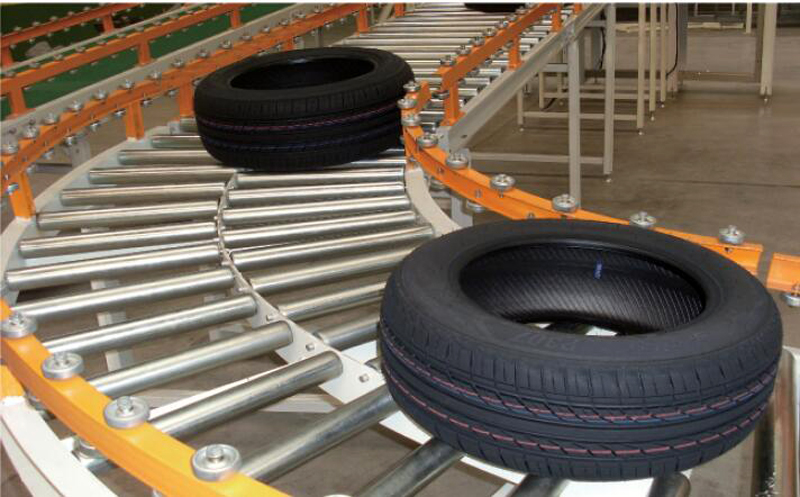
The Gravity Curved Roller Conveyor provides a simple and reliable solution for changing the direction of cartons, totes, pallets, and other stable unit loads without a powered drive system. Available in common turning angles such as 45°, 60°, and 90°, it can be integrated with straight gravity or powered conveyor sections to create smooth corner transfers.
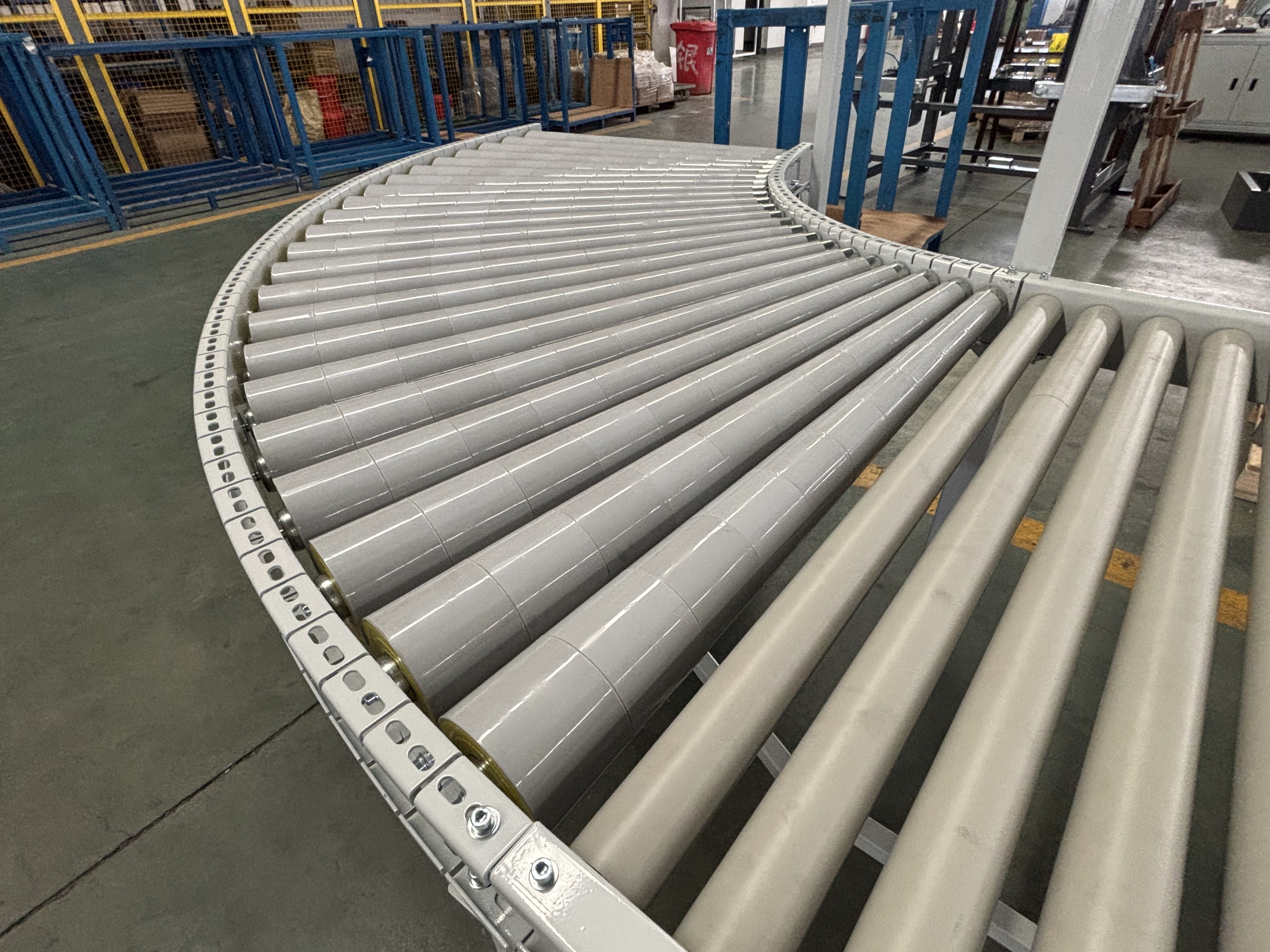
The conveyor uses tapered rollers to guide products through the curve while compensating for the different travel distances between the inner and outer sides. It can operate on a slight incline using gravity or horizontally with manual pushing, making it suitable for warehouses, distribution centers, production lines, and material handling systems.
A gravity curved roller conveyor is a non-powered conveyor designed to change the direction of material flow.
Goods move through the curve either by gravity or manual pushing. Unlike a straight roller conveyor, the curved section normally uses tapered rollers to help products maintain a stable orientation throughout the turn.
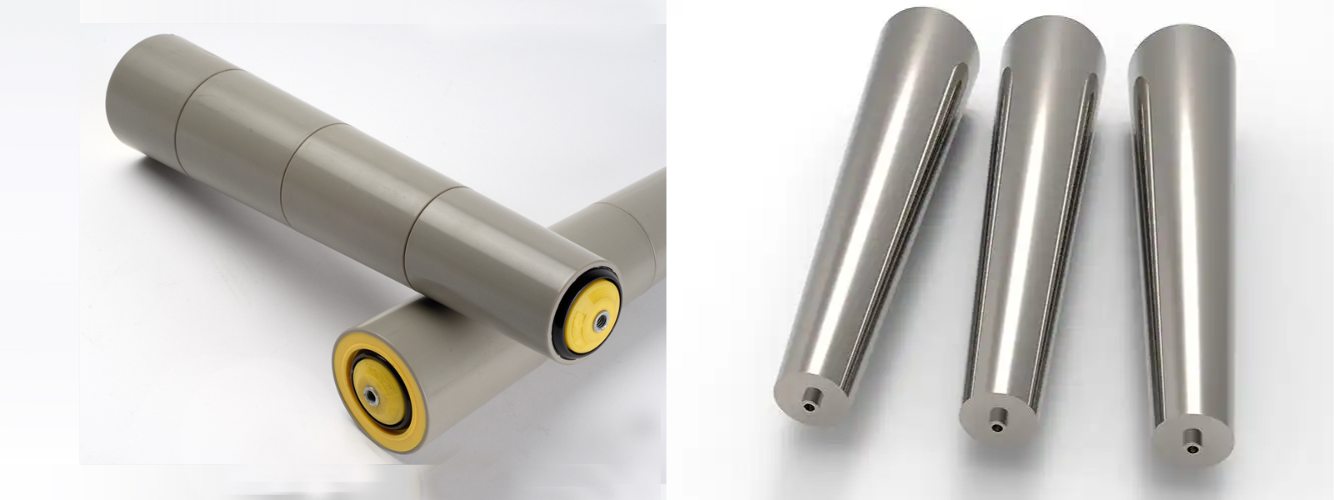
The roller diameter gradually increases from the inside of the curve toward the outside. Because the outer side of the product travels a longer path than the inner side, this tapered design helps compensate for the difference in travel distance and guides the load smoothly through the curve.
When the conveyor is installed with a suitable incline, cartons, totes, and other loads move through the curved section under gravity.
The required slope depends on product weight, bottom condition, roller resistance, conveyor length, and operating conditions.
The conveyor can also be installed horizontally.
In this configuration, operators manually push cartons, totes, pallets, or other suitable unit loads through the curved section.
This makes the conveyor useful for intermittent handling, picking, packing, assembly, and workstation transfer applications where powered conveying is not required.
The curved conveyor allows a material handling line to change direction without using a powered curve conveyor.
Standard turning angles include 45°, 60°, and 90°, with other configurations available according to the conveyor layout.
Tapered rollers help compensate for the different travel distances between the inner and outer sides of the curve.
This improves product guidance and helps cartons and other stable loads move through the turn with less side friction.
The gravity conveyor does not require its own motorized drive system.
Products can move under gravity on an inclined installation or by manual pushing on a horizontal conveyor.
The curved section can connect with straight gravity roller conveyors or powered conveyor sections to create a complete material handling route.
It is particularly useful for conveyor layouts where floor space or process flow requires a directional change.
Height-adjustable support legs allow the curved conveyor to align with upstream and downstream conveyor sections.
The height can also be configured to provide the required gravity slope.
Side guards can be installed along the inner and outer edges of the curved frame to help keep cartons, totes, and other unit loads within the conveying path during turning.
The conveyor mainly consists of a curved frame, tapered rollers, support legs, leveling feet, and optional side guards.
Component | Function |
|---|---|
Curved Frame | Provides the required conveyor turning angle and supports the roller assembly |
Tapered Rollers | Carry and guide products smoothly through the curve |
Support Legs | Support the conveyor and allow working-height adjustment |
Leveling Feet | Help align and stabilize the conveyor |
Side Guards | Help prevent products from moving outside the conveying path |
RONWIN offers different tapered roller configurations according to product weight, durability requirements, operating environment, and budget.
This configuration uses a standard steel roller fitted with an outer tapered sleeve.
The modular sleeve design provides an economical solution for many carton, tote, and medium-duty material handling applications.
Key Benefits:
Cost-effective construction
Low running noise
Replaceable tapered sleeve
Good corrosion resistance of the PP sleeve
Suitable for medium-duty loads
Convenient for manual-push applications
This option is recommended when cost, smooth operation, and easy component replacement are important.
The second configuration uses an all-steel tapered roller formed to provide the required curved conveying profile.
Its robust construction makes it suitable for applications requiring greater durability and heavier load handling.
Key Benefits:
Strong all-steel construction
Higher durability
Suitable for heavier unit loads
Good impact resistance
Surface treatments available according to requirements
Suitable for demanding industrial applications
This option is recommended when load capacity and long-term mechanical durability are higher priorities.
Feature | Steel Roller with Tapered Sleeve | Steel Plate-Welded Tapered Roller |
|---|---|---|
Construction | Steel roller with PP tapered sleeve | All-steel tapered construction |
Cost | Lower | Higher |
Running Noise | Lower | Relatively higher |
Maintenance | Individual sleeve replacement possible | Minimal routine maintenance |
Durability | Good | Excellent |
Typical Load | Medium-duty | Heavy-duty |
Corrosion Protection | PP sleeve resists corrosion | Surface treatment available |
Recommended Use | Cartons, totes and general material handling | Pallets and heavier industrial loads |
Selection Tip: Choose the tapered-sleeve version for general carton or tote handling where cost, quiet operation, and easy maintenance are important. Choose the all-steel tapered roller when greater durability and heavier load handling are required.
Parameter | Specification |
|---|---|
Conveyor Type | Gravity Curved Roller Conveyor |
Turning Angle | 45° / 60° / 90° |
Optional Turning Angle | 120° / 180° |
Roller Small-End Diameter | 50 mm |
Recommended Inside Turning Radius | Approx. 900 mm |
Standard Roller Taper | 3.6° |
Roller Taper Angle | ≤ 6° |
Frame Inner Width | 500 / 600 / 700 / 800 / 900 / 1000 / 1500 mm |
Frame Height | Approx. 300–1500 mm |
Frame Material | Bent Steel Plate |
Support Leg Material | Rectangular Steel Tube |
Maximum Load Capacity | Up to 200 kg |
Maximum Conveying Speed | Up to approx. 30 m/min under suitable gravity conditions |
Operating Temperature | Approx. -5 to +40 °C |
Conveying Mode | Gravity / Manual Push |
The standard 3.6° taper corresponds to an inside radius of approximately 800 mm for the applicable roller geometry, while approximately 900 mm is recommended for common conveyor configurations. Final radius should be selected according to product dimensions, conveyor width, and turning angle.
Specifications may vary according to roller configuration, product size, load, conveyor layout, and application requirements.
The gravity curved roller conveyor is designed for material handling systems that require cartons, totes, pallets, or other stable unit loads to change direction.
Use curved conveyor sections to connect straight conveyor lines around corners in receiving, picking, sorting, storage, and dispatch areas.
Tapered rollers help cartons and totes maintain a stable conveying path when changing direction through the conveyor curve.
Curved roller sections can transfer components, workpieces, or packaged products between production and assembly areas where the conveyor layout changes direction.
Horizontal gravity curves can be used for manual transfer between packing, inspection, assembly, or temporary storage stations.
When configured with suitable heavy-duty tapered rollers and structural reinforcement, the conveyor can be used for heavier unit loads and selected pallet-handling applications.
Several factors should be confirmed before selecting a curved conveyor.
Turning Angle
Determine whether the conveyor needs a 45°, 60°, 90°, or another turning angle according to the facility layout.
Product Dimensions
The length and width of the conveyed goods affect the required conveyor width and inside turning radius.
Product Weight
Confirm both individual product weight and required conveyor load capacity before selecting the roller configuration.
Bottom Surface
Gravity roller conveyors work best with cartons, totes, pallets, and other products that have sufficiently flat and rigid bottoms.
Turning Radius
Larger products generally require a larger turning radius to avoid interference with the conveyor side frame or guardrails.
Gravity or Manual Push
Use an inclined installation when products need to move by gravity. Choose horizontal installation when products will be moved manually.
Roller Configuration
Use tapered-sleeve rollers for general medium-duty handling or choose an all-steel tapered roller configuration for heavier and more demanding applications.
A gravity curved roller conveyor is a non-powered conveyor section designed to change the direction of cartons, totes, pallets, and other suitable unit loads. Products move through the curve by gravity or manual pushing.
Common configurations include 45°, 60°, and 90°. Other angles, including 120° and 180°, can be designed according to the conveyor layout.
The inner and outer sides of a product travel different distances during a turn. Tapered rollers help compensate for this difference and guide the product more smoothly through the curve.
Not always. An inclined conveyor allows suitable goods to move under gravity, while a horizontal conveyor can be used for manual pushing.
The conveyor is suitable for cartons, boxes, totes, trays, selected pallets, and other unit loads with sufficiently flat and rigid bottoms.
Standard configurations can support loads of up to approximately 200 kg, depending on roller configuration, conveyor dimensions, load distribution, and operating conditions.
The correct radius depends mainly on product dimensions, conveyor width, turning angle, and product orientation. Larger products generally require a larger inside turning radius for smooth corner transfer.
Yes. A gravity curved roller conveyor can be integrated with straight gravity conveyors or powered roller conveyor sections according to the overall material handling system.