
 |
| Material: | |
|---|---|
| Model Number: | |
| Quantity: | |
17
RONWIN
HS Code: 8431390000
1712, 1719, 1725
A stud-mounted ball transfer unit is a multi-directional rolling device consisting of one main load-bearing ball and multiple bottom support balls (or a retainer structure). Its most distinctive feature is a central threaded stud, which allows it to be directly screwed into a threaded hole in the equipment base like a bolt, enabling quick and secure installation.
Features: General purpose,adjustable height by thread, drilled hole fixing, low profile, alternative ball and thread sizes.

| ref no. | material | loading capacity (kg) | weight | |
| suggest | max. | |||
| 1712 | CS/CS | 8 | 13 | 18 |
| PL/CS | 3 | 7 | 12 | |
| SS/SS | 5 | 9 | 18 | |
| PL/SS | 3 | 7 | 12 | |
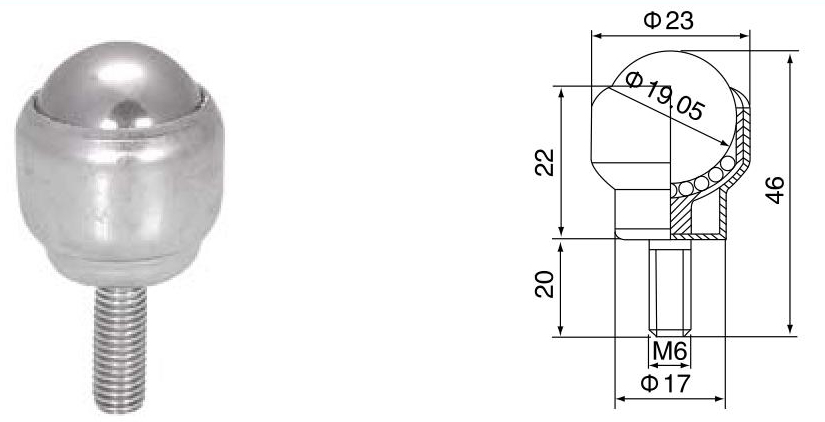
| ref no. | material | loading capacity (kg) | weight | |
| suggest | max. | |||
| 1719 | CS/CS | 15 | 20 | 50 |
| PL/CS | 7 | 10 | 30 | |
| SS/SS | 10 | 15 | 50 | |
| PL/SS | 7 | 10 | 30 | |
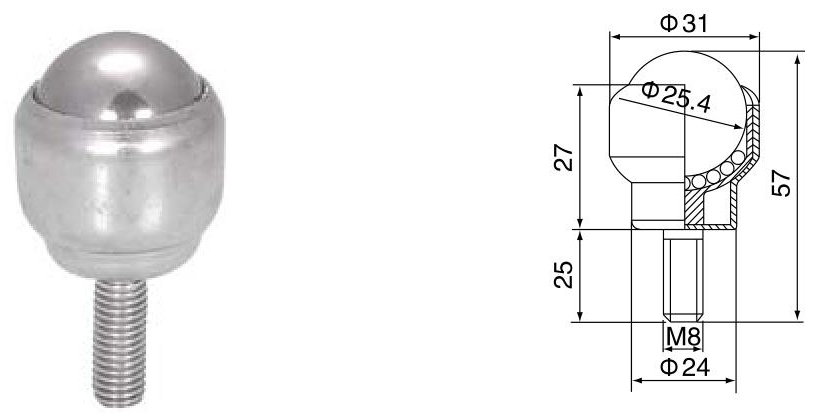
| ref no. | material | loading capacity (kg) | weight | |
| suggest | max. | |||
| 1725 | CS/CS | 30 | 40 | 120 |
| PL/CS | 15 | 20 | 60 | |
| SS/SS | 20 | 30 | 120 | |
| PL/SS | 15 | 20 | 60 | |
Main Load-Bearing Ball: The large top ball (steel, nylon, or stainless steel) that contacts the load directly, responsible for bearing the weight and providing omnidirectional rolling.
Housing/Socket: The casing that houses the main ball, featuring a precision-machined spherical inner raceway.
Support Balls: A circle of smaller balls located beneath the main ball. They transfer the load from the main ball to the housing and significantly reduce its rotational friction, allowing for flexible and smooth omnidirectional movement.
Central Stud/Bolt: Integrated or firmly attached to the housing, serving as the mounting stem for the entire unit.
Dust Cover/Seal: Some models include seals or covers to prevent dust and debris from entering and affecting performance.
Working Principle: When a load moves across its surface, friction causes the main load-bearing ball to rotate. Supported by the underlying small balls, the main ball can rotate easily in any horizontal direction, thereby converting sliding friction into rolling friction and greatly reducing the force required to move the load.
Easy Installation: Requires no complex fixtures. Simply drill and tap a threaded hole in the mounting plate, then screw and tighten.
Compact Structure: Saves space, especially suitable for applications with limited vertical clearance.
High Load Capacity: Depending on size and material, a single unit can handle loads ranging from tens of kilograms to several tons.
Flexible Omnidirectional Movement: Provides smooth, all-angle rolling for easy workpiece repositioning.
Simple Maintenance: Some models are lubricatable for extended service life and durability.
Stud-mounted ball transfers are fundamental components for "point-based" rolling conveyance solutions, widely used in:
Conveyor Systems: As auxiliary turning, positioning, or transfer stations.
Machine Tool Processing: For easy movement and positioning of heavy workpieces (e.g., molds, frames) on worktables.
Material Handling Systems: Installed on pallets, skids, and cart bottoms.
Warehousing Equipment: For turntables, sorters, and heavy-duty rack unloading areas.
Packaging & Printing Machinery: Supporting and transferring paper rolls, material reels.
Automotive Manufacturing: Conveying car bodies and components on assembly lines.
DIY & Special Equipment: Such as rotating display stands, large furniture movers, etc.
Thread Specification: The most critical parameter. Examples: M10, M12, M16 (metric) or 1/2”-13, 5/8”-11 (imperial). Must match the threaded hole in the mounting plate.
Mounted Height: The total height from the mounting surface to the top of the main ball.
Ball Diameter & Material:
Diameter: Common sizes: 12mm, 19mm, 25mm. Generally, larger diameter means higher load capacity.
Material: Carbon Steel Zinc-Plated (most common, economical), Stainless Steel (corrosion-resistant, for food/medical grade), Nylon/POM (rust-proof, scratch-resistant, low-noise).
Dynamic/Static Load Rating: Typically in kilograms (kg) or Newtons (N). Static load is the maximum weight when stationary; dynamic load is the recommended capacity during movement.
Operating Environment: Consider need for corrosion resistance (choose stainless steel), high temperature tolerance, chemical resistance, etc.
Mounting Plate Strength: The plate must have sufficient thickness and strength. Threaded holes must be drilled perpendicular and properly sized.
Preload/Tightening Force: Use appropriate tools (e.g., wrenches) to tighten securely, but avoid over-tightening which can damage threads.
Layout Design:
Even Load Distribution: Multiple units should be evenly spaced under the load to share weight.
Maintain Coplanarity: The tops of all ball transfer balls must be on the same level plane to ensure stable load movement.
Reasonable Spacing: Excessive spacing can cause load sagging and jamming. Typically, spacing should be less than half the smallest dimension of the load's contact surface.
Maintenance: Regularly clean the ball surface, check for smooth rotation, and add lubricating grease if necessary.
Alternative Material & Sizes


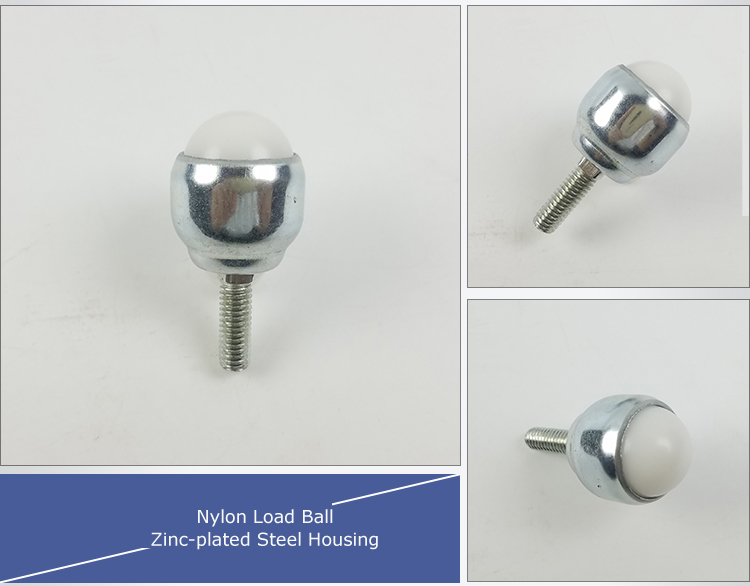
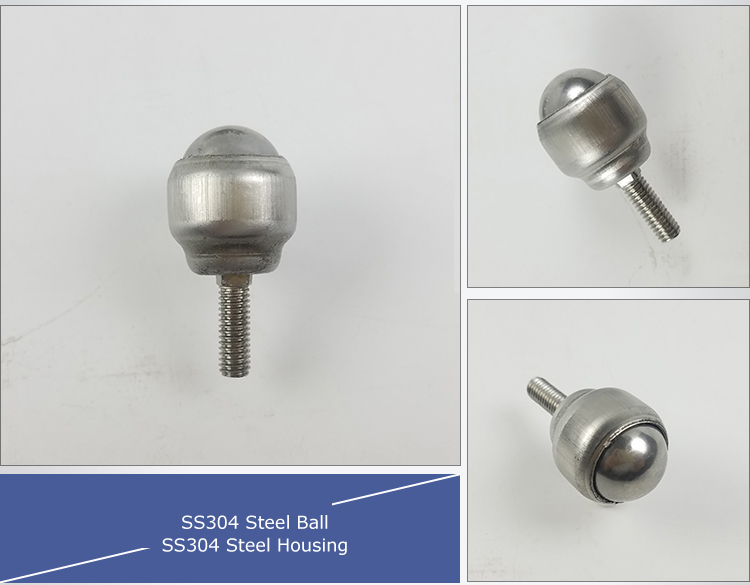
vs. Flange-Mounted/Recessed Ball Transfers: Stud-mounted types install via threads, saving more vertical space. Flange-mounted types secure via peripheral screws, better for thin plates or where tapping threads is impractical, offering higher pull-out resistance.
vs. Spring-Loaded Ball Transfers: Stud-mounted types have a fixed height; spring-loaded types can absorb shock and adapt to uneven load surfaces.
Ball transfer units are a multi-directional, material handling system. Moving in all directions, ball transfer units enable the easy transfer of light and heavy loads — changing the direction of motioninstandtly.
There are many possible applications where loads needs to move smoothly, precisely and with a minimum effort in any direction. Some typical applications include cargo and baggage handling, assembly lines, as a castor, machine loading, sliding-door systems, machine tables, etc.


