
 |
| Material: | |
|---|---|
| Model Number: | |
| Quantity: | |
65
RONWIN
HS Code: 8431390000
This is a miniature ball transfer unit with a threaded stud mount, also commonly known as a "ball plunger" or "spring-loaded ball transfer." It consists of a high-precision ball (typically made of stainless steel) housed within a body featuring a threaded mounting stud. The ball can rotate omnidirectionally with low friction. Its core function is to convert sliding friction into rolling friction, enabling precise, smooth movement, and positioning.
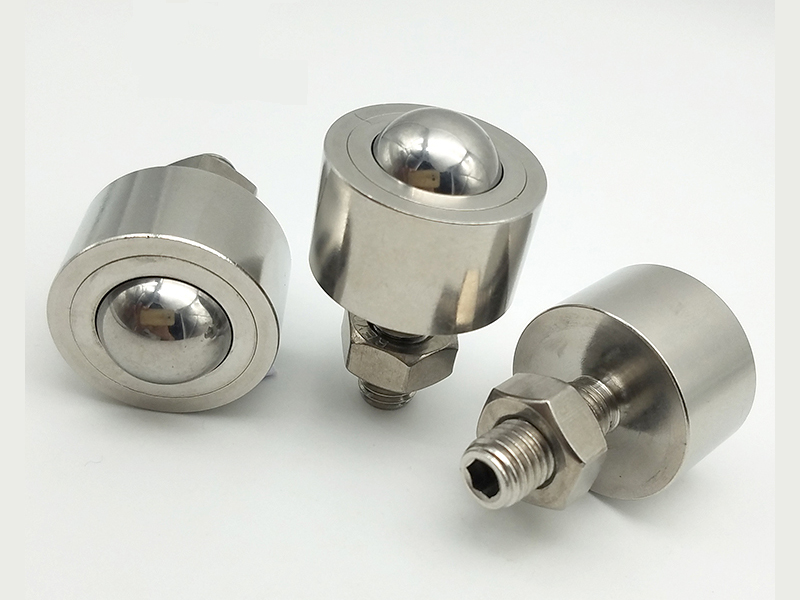 Very Low Rolling Friction: Enables smooth and precise movement with minimal driving force required.High Precision and Consistency: The precision-made ball and body ensure smooth operation and high repeatability in positioning.
Easy Installation: The threaded stud allows for direct screwing into a tapped hole in the equipment, making installation simple, secure, and free of complex fixtures.
Miniature Design: Its small size makes it suitable for precision equipment where space is limited.
Durability and Corrosion Resistance: The stainless steel construction allows it to adapt to various industrial environments, including those requiring cleanliness or having mild corrosive elements.
High Load Capacity: Despite its small size, thanks to the high-hardness materials, a single ball transfer unit can withstand considerable loads.
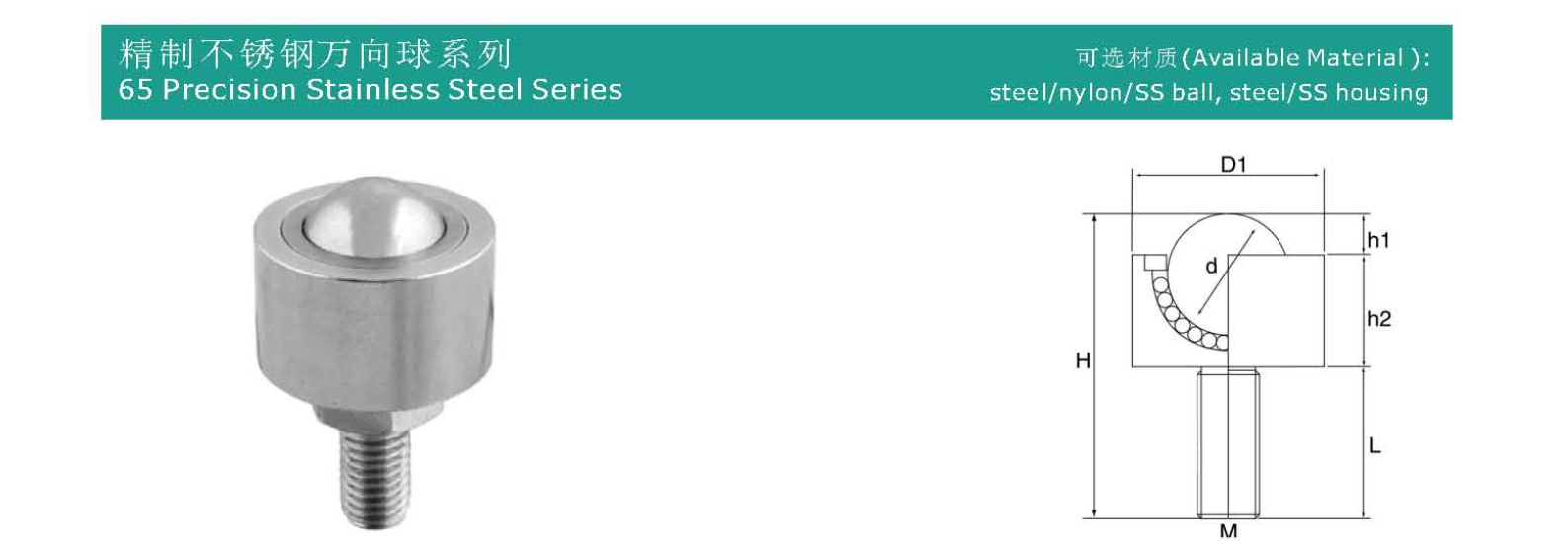
| Model No. | Loading Capacity (kg) | Dimensions (mm) | ||||||||
| Material | Suggest | Max. | d | D1 | H | h1 | h2 | M | L | |
| 6505 | SS/SS | 4 | 5 | 5.56 | 12 | 23 | 1.5 | 6.5 | M6 | 15 |
| 6508 | SS/SS | 6 | 7 | 8.73 | 16 | 27 | 2.5 | 9.5 | M6 | 15 |
| 6510 | SS/SS | 8 | 10 | 10.32 | 19 | 35 | 3.5 | 11.5 | M8 | 20 |
| 6515 | SS/SS | 12 | 18 | 15.87 | 25 | 40 | 5.3 | 14.7 | M8 | 20 |
| 6519 | SS/SS | 15 | 20 | 19.05 | 31 | 50 | 6.3 | 18.7 | M10 | 25 |
Precision Ball: Typically made of high-grade stainless steel (e.g., 440C), it undergoes heat treatment and precision grinding to achieve high hardness, wear resistance, corrosion resistance, and a very low surface roughness.
Body and Threaded Stud: The body houses the ball and typically contains a built-in spring and pressure adjustment mechanism. The threaded stud at the base (e.g., M3, M4, M5, M6 metric threads) is used for secure installation.
Internal Pressure and Return Mechanism: A built-in spring provides constant downward pressure on the ball, ensuring it maintains good contact with the load surface and automatically returns to its original position after being depressed.
When a workpiece or equipment component presses against the ball and moves, the ball rotates due to the applied friction.
Because it involves point contact and rolling friction, the dynamic friction is much lower than sliding friction. This results in low-effort, smooth, and non-stick precise linear or rotational movement.
Threaded Stud Mount: Specifies the installation method, indicating it has an external thread that screws into a tapped hole in the base plate, much like a bolt.
Stainless Steel: Indicates the primary material, ensuring strength, wear resistance, and corrosion resistance.
Precision: Emphasizes its small manufacturing tolerances, smooth operation, and suitability for high-precision applications.
Miniature: Indicates its small size, typically with a ball diameter between 3mm and 10mm, and a correspondingly small thread diameter.
Ball Transfer Unit: Indicates its core function – the ball can rotate freely in any direction.
This product is a critical component in automation equipment, precision instruments, and tooling fixtures. It is commonly used in.
Precision Linear Slides: Serves as a passive support roller, assisting the main guide rail in achieving smooth, non-slip movement.
Heavy Load Handling and Shifting: Installed underneath a platform and used in conjunction with a smooth base plate to easily move heavy workpieces or equipment.
Tooling Fixtures and Positioning Mechanisms: Used in CNC machining and inspection equipment to support and guide workpieces, enabling fast and accurate positioning.
Conveying and Sorting Systems: Acts as a low-resistance guide wheel in sections that require direction changes or gentle pushing.
Instruments and Office Equipment: Used inside devices like scanners and printers to support moving components.
Ball Diameter: e.g., 5mm, 6.35mm (1/4 inch), 8mm, etc.
Threaded Stud Specification: e.g., M4x0.7, M6x1.0, 1/4"-20UNF, etc.
Total Height / Mounting Height: The overall dimensions after installation.
Static Load Capacity: The maximum safe load it can bear in a stationary state.
Dynamic Load Capacity: The recommended load it can withstand while rolling.
Ball Material and Hardness: Commonly 440C stainless steel, with HRC ≥ 58.
Spring Force: The force required to depress the ball, which affects contact stability and flexibility.
The Stainless Steel Miniature Ball Transfer Unit with Threaded Stud Mount is a small yet vital engineering component. Through its clever mechanical design, it transforms hard-to-control sliding friction into efficient rolling friction. This provides a smooth, low-effort, and precise motion solution for various precision equipment. Its robust, durable, and easy-to-install characteristics make it an ideal choice for engineers designing highly reliable automation systems.


