
 |
| Material: | |
|---|---|
| Model Number: | |
| Quantity: | |
62
RONWIN
HS Code: 8431390000
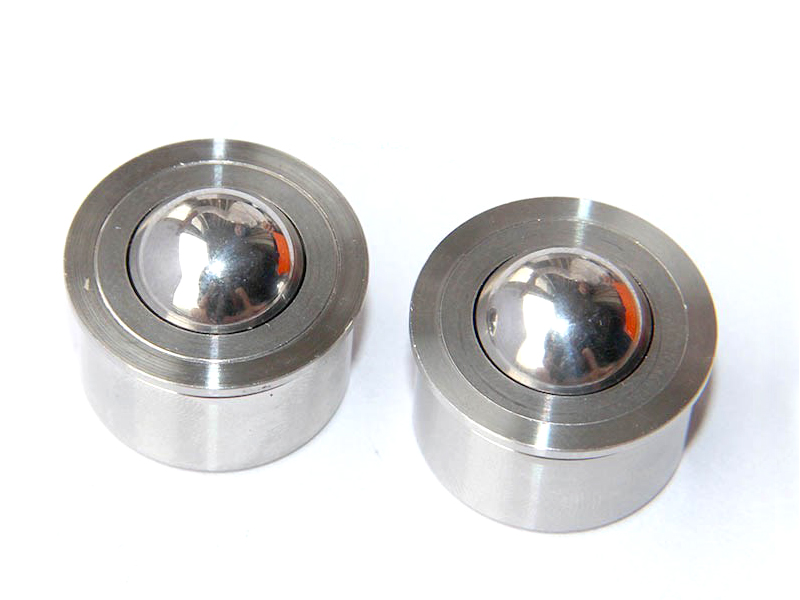
A Stainless Steel Precision Miniature Ball Joint, often referred to as a "Precision Ball and Socket Joint" or "Miniature Ball Bearing," is an extremely small, high-precision mechanical component. Its core function is to enable multi-directional flexible rotation and precise angular adjustment within a fixed housing. This is achieved through a high-precision stainless steel ball rotating freely within a precisely matched socket.

6204, 6205, 6206, 6208, 6210, 6215, 6219
In the broad range of Longwei Automation, the mini ball transer unit is the tiniest ball transfer unit. With quality assurance, mini units are used across a broad range of industries, can be used to exact transfer and position small parts in demanding material-handling settings, including cleanrooms with limited space and operating conditions. Mini ball transfer units offer exact movement and positioning, and they can be used with the ball upwards or downwards. A CNC machine is used to make a solid stainless steel body with stainless steel balls and plain body fixing.
Depending on type, “miniature” ball transfer units are designed with ball sizes ranging from 4mm to 19mm. Units weigh from 5g to 185g and are offered with load ratings from 2kg to 20kg (up to 44 lbs.). The dimensions and loading capacity is refer to the following chart.
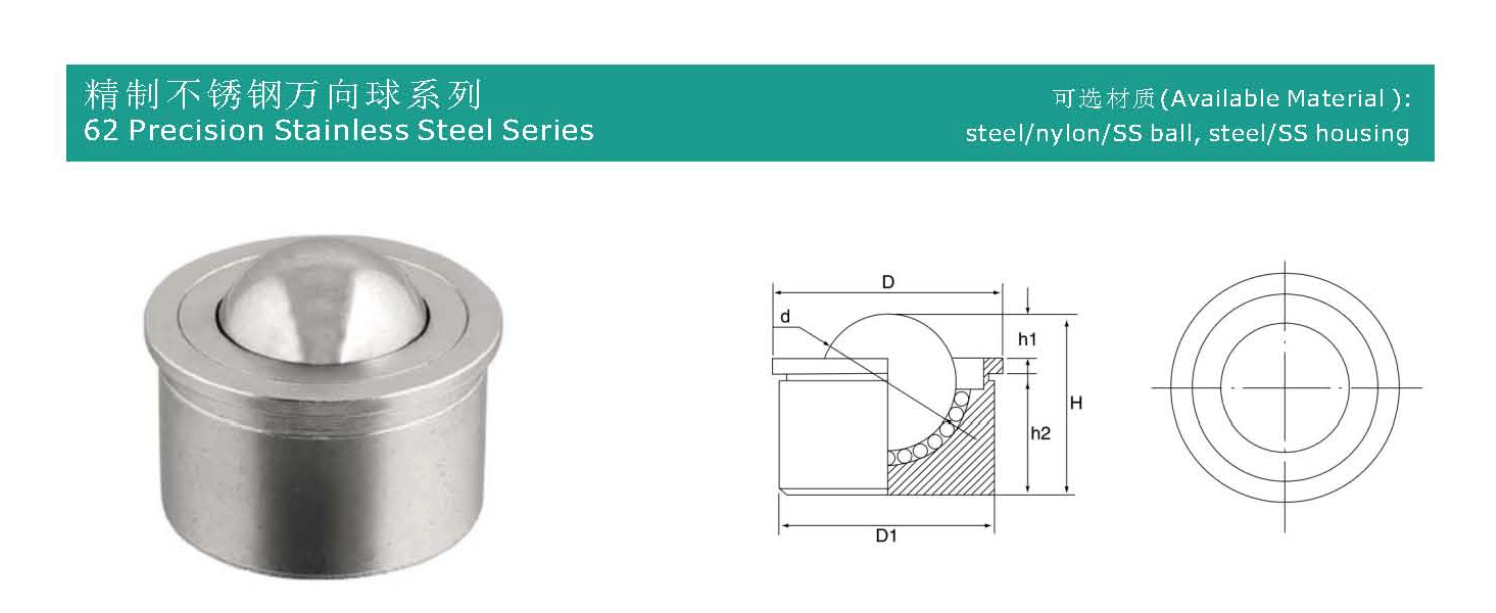
| Model No. | Loading Capacity (kg) | Dimensions (mm) | Weight (g) | |||||||
| Material | Suggest | Max. | d | D | D1 | H | h1 | h2 | ||
| 6204 | SS/SS | 2 | 3 | 4 | 9 | 7.5 | 6.1 | 1.1 | 4 | 5 |
| 6205 | SS/SS | 3 | 4 | 4.76 | 11 | 9 | 7.2 | 1.2 | 5 | 8 |
| 6206 | SS/SS | 4 | 5 | 5.56 | 13 | 11 | 8.5 | 1.5 | 6 | 10 |
| 6208 | SS/SS | 6 | 7 | 8.73 | 17 | 15 | 12.5 | 2.5 | 9 | 15 |
| 6210 | SS/SS | 8 | 10 | 10.32 | 20 | 18 | 14.5 | 3.5 | 10 | 30 |
| 6215 | SS/SS | 12 | 18 | 15.87 | 26 | 24 | 20.8 | 5.3 | 14 | 60 |
| 6219 | SS/SS | 15 | 20 | 19.05 | 32 | 30 | 25.3 | 6.3 | 17 | 185 |
Extremely small size, typically with ball diameters ranging from 1mm to 10mm, or even smaller. The compact structure is ideal for precision instruments and equipment with limited space.
The ball and socket are precision-ground and polished to achieve exceptional sphericity, surface finish, and dimensional tolerances.
Very low rotational friction and starting torque ensure smooth, responsive, and non-stick movement.
440C: A high-carbon martensitic stainless steel, it is the most common choice. After heat treatment, it offers very high hardness (HRC 58-62), excellent wear resistance, and good corrosion resistance.
304/316: Prioritizes superior corrosion resistance, making it suitable for harsh environments like chemical, medical, and food industries, though with relatively lower hardness.
Materials: Commonly manufactured from 440C, 420C, or 304/316 Stainless Steel.
Advantages: Corrosion resistance, wear resistance, high strength, non-magnetic (or weakly magnetic), and long service life.
As a "universal" joint, it can pivot and rotate in any direction within a certain conical angle (typically less than ±30°), enabling complex multi-degree-of-freedom motion.
Despite its small size, the use of high-strength stainless steel and precision design allows it to withstand relatively significant radial and axial loads for its dimensions.
Usually pre-lubricated with grease from the factory, allowing for maintenance-free operation in most environments. Can be re-lubricated if necessary to extend service life.
Due to its exceptional characteristics, it is indispensable in many high-tech and precision fields:
Precision Instruments & Optical Equipment: Used in laser alignment systems, microscope focusing mechanisms, and angular fine-tuning devices for optical lenses.
Automation & Robotics: Serves as a minor compensation element in robot joints, a connection point in precision transmission mechanisms, and a leveling mechanism in 3D printers.
Medical Devices: Applied in surgical robots, endoscopes, dental equipment, and precision infusion pumps, where high cleanliness and reliability are required.
Aerospace & Defense: Used in gyroscopes, seeker heads, inertial navigation systems, and other applications demanding extreme precision and reliability.
Electronics & Semiconductor: Used for precise positioning and as a buffer element in chip test fixtures and wafer handling equipment.
High-End Consumer Goods: Such as gimbals for high-end cameras and mechanisms in precision watches.
When selecting this product, pay attention to the following parameters:
Ball Diameter: The core dimension that determines the overall size of the product.
Shank Diameter & Overall Length: Dimensions of the mounting part.
Thread Specification: Common metric threads like M3, M4, M5, or imperial threads, used for installation and fixation.
Load Capacity: Includes both axial and radial load ratings.
Swivel Angle: The maximum allowable deflection angle.
Material & Hardness: Chosen based on wear and corrosion resistance requirements.
Precision Grade: Such as spherical tolerance of the ball and surface roughness (Ra value).
In conclusion, the Stainless Steel Precision Miniature Ball Joint is a gem in modern precision engineering. It integrates high-strength materials, miniaturized manufacturing processes, and high-precision standards, providing a perfect solution for applications that require flexible, smooth, precise, and reliable multi-directional movement within a minimal space. It is a key fundamental component for enhancing equipment performance and achieving precise control.


